



#Rendar Frankenstein
[Interview] Barbara Ciardo’s True Colors
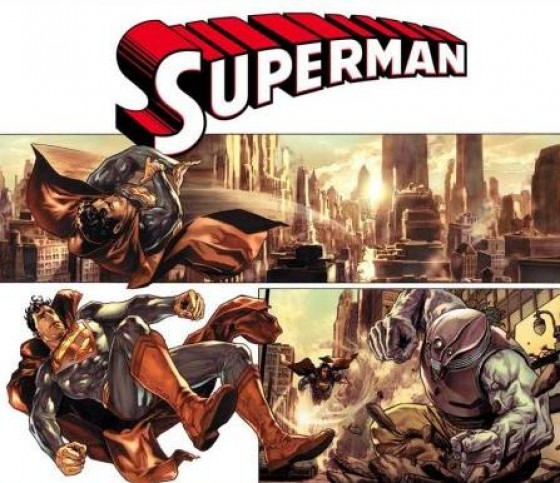
If you haven’t been reading DC’s Wednesday Comics then you’re either stupid or crazy. Provided you’re not both, go to your local comic shop right now buy as many of them as you can. Yes, they’re that good.
Those of you who have been picking up this weekly treat have probably already decided which strips are worthwhile and which aren’t. To me, the only real toss-away strips are Metal Men (apparently DiDio writes an interesting story about as well as he edits), Teen Titans, and (until last week, anyways) Caldwell’s Wonder Woman. Other than that, we’re talking straight-up comic-book masterpieces.
One of these masterpieces is Superman. The story is simple enough — Superman is having some sort of existential crisis and he travels about while trying to figure out what it all means. The execution, however, is perfect. Arcudi’s writing and Bermejo’s pencils depict Kal-El as both iconic and humanly relatable. Kudos to them.
But what I find most breathtaking about this comic are the colors. When I fold open the newspaper-style strip, my eyes explode and nearly knock the lenses out of my glasses. I don’t even know what to write…the colors of this Superman strip are just perfect. Vibrant, warm, welcoming, heavenly.
So once I realized that I was in love with the colors, I decided to contact the woman responsible: Barbara Ciardo.
No Comments
Zapped! by Zapata
Whenever I wander around Warren Ellis’ Whitechapel Forums (which is pretty much everyday) it doesn’t take long before I find something worthwhile. Some days, it’s a new book to read or an 8tracks mixtape or some scientific article I can barely wrap my head around. In other words, Whitechapel is a failsafe source of discovery.
Today was no exception. Browsing the Splash Page Art Challenge Thread, I was struck by the work of George Zapata (who posts as ‘gzapata’). His submission (as seen below) wonderfully depicts the differences between Batman & Superman. And while this interplay between light/dark, cheerful/brooding, inspiring/frightening has been explored ad nauseam, Zapata’s effort is much more refreshing and playful.
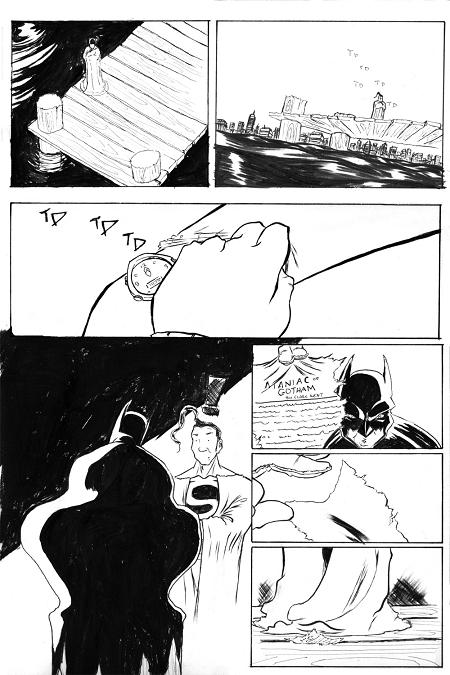
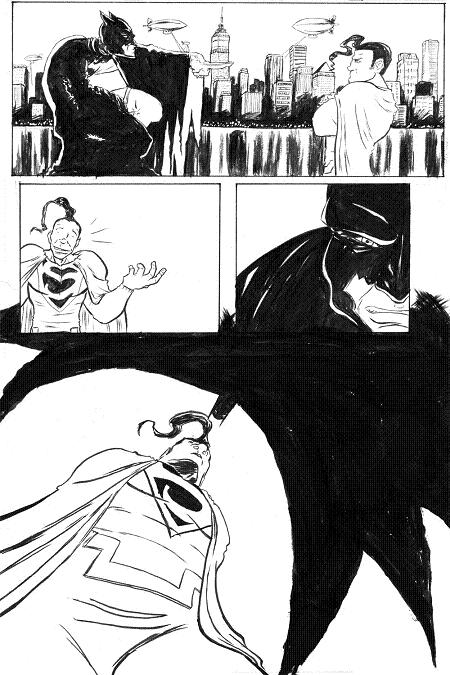
From Superman’s ridiculous hair-curl to Batman’s scowl, Zapata helps the reader remember that these are cartoons — they don’t always have to be complicated characters of socio-cultural critiques. Sometimes, believe it or not, comic books can just be fun – and that’s exactly what these two pages prove.
I made my way to Zapata’s website to discover that he is a former student of the Joe Kubert School of Cartoon and Graphic Art and is trying to cut his teeth in the comic book world. I emailed George and asked for permission to post these images and he has yet to respond. With that being said, I’m going to assume he’s cool with it.
Go to his blog. Check out his sick art. Let him know what you think. Help out the small guys.
Friday Brew Review – Jack’s Pumpkin Spice Ale

It’s Friday. Finally. TGI-fuckin’-F or whatever. If only it were 1989 again and I could rock the TGIF lineup, I may not have need to write this. But alas, times have changed and I can no longer rely on ABC’s transdimensional-series cameos to help kill the memories of the week.
Instead, I need a cold brew. And since I’m drinking anyways, I figure that I might as well take the opportunity to review the beverage for the six diehard, dedicated readers of OL.
Tearing Apart an Old Favorite: X-Men #25
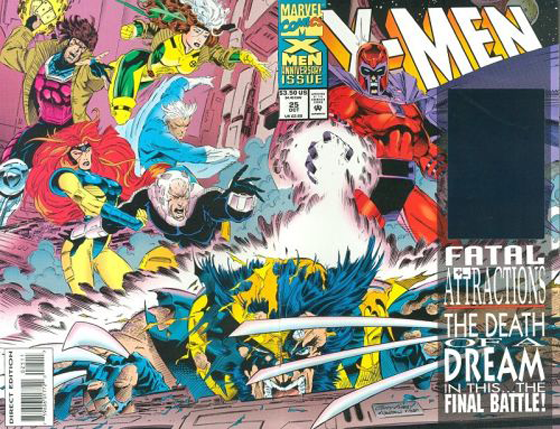
Earlier this afternoon I dug through the archives I share with Caffeine Powered, as I was on a mission to find one of my all-time favorite comic books. Thanks to the wonderful organization skills of my brother, it was with minimal effort that I was able to pump my fist and shout “Huzzah!” I held in my hands X-Men #25, the very first comic I remember reading.
Actually, I need to pause for clarification. X-Men #25 was not the first comic book I owned. Looking at it today I realized that the comic was published in October 1993; as a seven year old at that time, I must have already been familiar with paneled pages.
Furthermore, when I first got my hands on X-Men #25 almost sixteen years ago, I didn’t read it. In fact, I’m not sure if I could read at that age. But even if I was literate, I distinctly remember skipping the words in favor of the images (sorry Fabian Nicieza!).
Lusting For Wonder
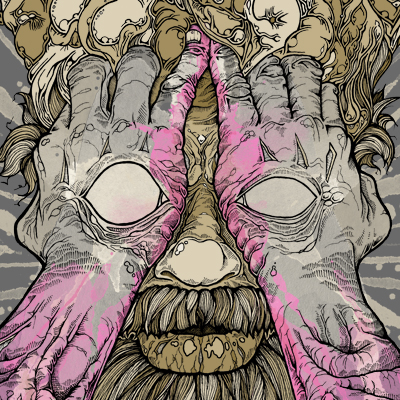
Every Time I Die has been one of the few bands whose albums retain unchallenged positions in my personal rotation. Especially in their last effort (2007’s The Big Dirty), ETID combine straight-ahead thrash & paralysis-inducing breakdowns with southern-rock groove & clean hooks to create an irresistible sonic cocktail.
The garnish, of course, is Keith Buckley’s penchant for crafting evocative, powerful lyrics. Buckley’s anecdotes act as supportive frames, giving the listener just enough to imagine a more personal narrative. I’m not sure, but I’d bet that I’m not the only ETID fan who finds himself pondering lyrics such as those found at the end of Imitation is the Sincerest Form of Battery:
Stay wistful and young.
The affected are banking on oblivion
In the drone of embittered hope.
And we’re sold by the way they wrote it.Oh, it’s the end of the line
I’m cornered by a precedent
The sneering public eye.It is better to destroy than to create what is meaningless.
So the picture will not be finished…
Or maybe I just give Keith Buckley too much credit because he was a literature student & high school teacher. I don’t know.
In any case, September 15th sees the release of New Junk Aesthetic. I’ve been looking forward to this album for quite some time and have held my head high despite some more disparaging news (i.e. Fall Out Boy’s Pete Wentz contributing guest vocals & the departing of longtime drummer Mike “Ratboy” Novak).
My optimism for New Junk Aesthetic is instead rooted in the fact that it was completed before Novak left, providing one last documented recording of the foursome (Novak/Williams/the brothers Buckley) that I’ve learned to love. Further, my love for sweet album packaging is appeased by the stellar artwork of guitarist Jordan Buckley.
Yesterday, Wanderlust was released as the first official video for the new album. I’m still sorting out my feelings about the track, but my initial impression is favorable. That may change. Or it may not. But for right now, I’m going to pump my fist and contemplate the following:
We’ve lived under this dark cloud forever
Waiting for the bad light to break.Just let me try that one again, with a little more feeling –
We slept at the crossroads together, trying to make an honest mistake.
Just let me try that one more time, without a smile on my face.
Give the video a view and tell me what you think.
Every Time I Die – “Wanderlust”
Stranger Comics
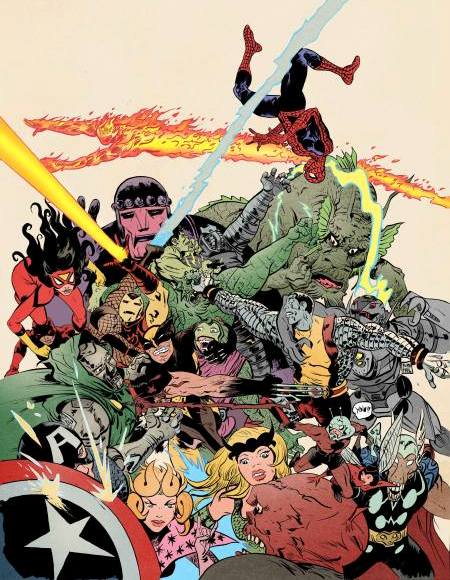
Looking ahead to the next few weeks’ comic releases, I realized that September 2nd brings the first issue of Strange Tales Max. This three-issue miniseries is composed of short stories by some of the most acclaimed creators in underground comics, many of whom have seized the opportunity to run amok with Marvel’s more recognizable characters.
On the one hand, I think this series could be great for all involved parties; the creators gain exposure that their usual work does not afford them, Marvel gets to tout a badge of artistic merit, and the readers get their filthy paws on some unique work. If all goes to plan, Strange Tales Max could be responsible for quite a few Eisner-nominations.
However, such an endeavor also runs the risk of choking on the vomit of its own novelty. Comic book fans are, on the whole, not a group who like their mothers’ apple pie recipes fucked with. If Marvel runs a story about Peter Parker giving up the superheroics in favor of free-form dance, then they might just shoot themselves in the foot.
Quirky or novel are not always synonymous with successful. Just ask DC’s Wednesday Comics — despite heavy promotion, its first issue was only the thirty-sixth best selling comic of July (with subsequent issues faring worse). And even though I think it contains some of the best story-telling I’ve read lately (Kerschl/Fletcher’s The Flash/Iris West, Pope’s Strange Adventures, & Busiek/Quinones’ Green Lantern comes to mind) even I can’t get over the shitty newsprint material. In my opinion, such beautiful art shouldn’t be folded over and printed on gray toilet paper.
Perhaps Wednesday Comics may work better once it’s collected into an absolute edition. Maybe Strange Tales Max will be unappreciated until collected into a full anthology. Either way, both should be commended for the ways in which they strive for something else.
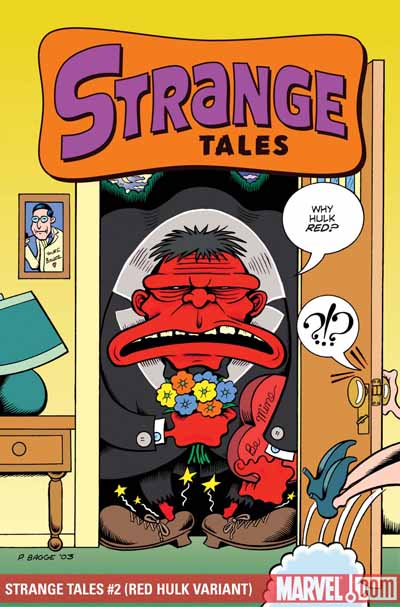
Strange Tales #2's cover is from Peter Bagge's "The Incorrigible Hulk"
He’s His Own Grampa
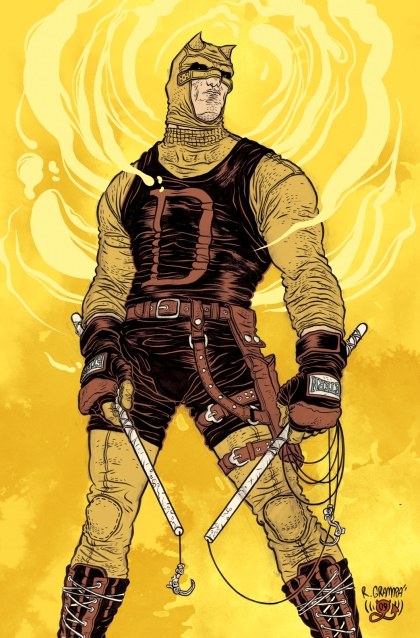
In addition to the twist conclusion of Ed Brubaker’s entire run, Daredevil #500 features an addendum that happens to bring with it a hope for tomorrow. More precisely, the pin-up section includes a piece by Rafael Grampa that can only be described as fucking amazing.
Grampa’s Daredevil (pictured above) is both refreshing and reverent — the old yellow/red costume has never looked more vibrant or alive, full of that indefinable essence that readers perceive as artistic enthusiasm.
Staring at the pin-up for quite some time, I became enamored with its realistic depiction of Matthew Murdock. Although much more impressive than my scrawny frame, the physique of this Daredevil appears to be no greater than that of any modern mixed-martial artist. Furthermore, the bootlaces, shirt, leather straps and boxing gloves summon the same spirit Paul Pope conjured for Batman Year 100, the notion that maybe, just maybe, superheroes could exist.
Having never heard of Rafael Grampa, I decided to find out for myself whether he was just a rip-off artist of Paul Pope (of whom I have invested much of my fanboy stock) or a legitimate talent. After making my way to his blog, I am now ruling in favor of the latter.
Rafael Grampa, which (according to my nonexistent understanding of Portuguese) roughly translates to Raphael Grandfather, is apparently quite the sensation in Brazil. He is a well-known graphic artist, designing not only comics but t-shirts, animations, toys, and even concepts for ESPN ads. The man even has a column at the website for MTV Brasil, which I would check out if English weren’t my only language.
So once I understood Grampa to be a respected (rising) star of sequential art, I made the egregious mistake of wondering, “What other superheroes can he draw?!?!” It didn’t take me long to find this:
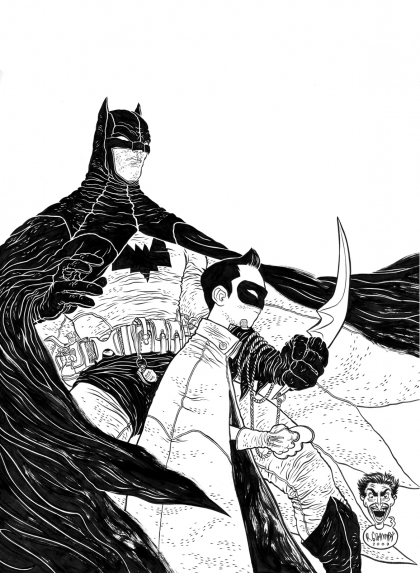
In my estimation, that is a sick Batman and an even better Robin. I really love the over-sized mask and the band-aid on Robin, adding an element of youthful inexperience which is generally overlooked. Again, this style does have a tinge of Pulphope in it, but not to the point that accusations should be flung.
With my urges to see men in tights and capes subsided, I was able to look into the Grampa’s more substantial work. As I discovered shortly thereafter, Rafael Grampa created 2008’s Mesmo Delivery, which tells the tale of an ex-boxer turned transporter and is tinged with a Twilight Zone otherworldliness. The one-shot has received crazy critical acclaim and is actually sold out. This puts me in a shitty situation, as I can either wait until Dark Horse reprints it next year or shell out some serious cash. I’ll probably suck it up and spend the money now, as I can’t stop looking at whatever previews/teasers I can find:
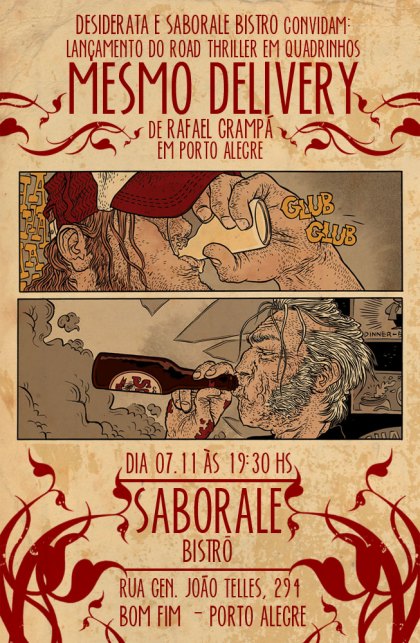
Deep down, I really hope that Rafael Grampa does whatever it is that he finds artistically fulfilling. But I’d be hard-pressed to deny the appeal of that Daredevil pin-up. In my ideal world, he’ll do what a lot of artists find themselves doing — both the artsy stuff and the commercial properties (which pay the bills). It is my belief that when genuinely talented creators put fresh spins on the dependable franchises, the readers finally get to see their favorite characters elevated (if only for a brief period) to higher strata.
Here’s to hoping Rafael Grampa sticks around to help us get to those upper echelons.
Cudi Isn’t Kiddin’

Kid Cudi is mainstream hip hop’s next potential savior.
Ok, let me step back and add a preface — I’m a twenty-two year old, white & nerdy (-6 points for the Weird Al reference) suburbanite who grew up listening to metal and drumming in a prog-metal band. With that being said, I truly believe that Kid Cudi is going to be next great, worthwhile hip hop act.
“Well, Pepsibones, what makes you think that?”
Well, three key points (which, for my sake, can be conveniently listed) stand out:
1) Exposure — This dude is getting pushed hardcore. As I said, I generally keep my ear turned to the harder hitting scenes/bands. And yet, I can’t help but hear about the sickness that is Kid Cudi. Between the Day’n’Nite single receiving continuous (or is that incessant?) radio play and features such as that in last month’s Spin, Cudi seems to be sneaking into the (pop) cultural consciousness. I mean, fuck, when I loaded up OL today the guy popped into the banner at the top and said hello to me.
In short, Kid Cudi is getting the media push needed to help hip hop. Don’t misunderstand me, I’m sure there are plenty of better (whatever that means) underground rappers — but without the exposure their words aren’t going to reach the masses. While I might have hoped for last year’s Esoteric vs. Japan: Pterodactyl Takes Tokyo! to have received more attention, I wasn’t surprised when it didn’t blow up and change the game; the exposure just wasn’t there. With Kid Cudi, it is.
2) Stylistic Plurality — When I subject myself to the radio or MTV, I usually find myself balking like the old man on the block, “Bah! All this rubbish sounds the same!” In the era of five-second ringtone hooks and a reliance on autotuner that makes Kirk Hammett’s wah-pedal use look like occasional experimentation, anything that breaks the mold is greatly appreciated. Not only does Kid Cudi bring a different, more earnest perspective, he presents it a number of different ways.
The A Kid Named Cudi mixtape features mellow, introspective numbers like 50 Ways to Make a Record & Man on the Moon (which shares its name with Cudi’s full-length), the danceable stoner’s love song that is Maui Wowie, a couple of more freestyle-feeling showcases such as Cudi Spazzin’, and hometown anthem Cleveland is the Reason (it is shocking that I’ve yet to see this track supporting a montage of King James dunks).
If Man on the Moon makes use of even half of the styles found on Cudi’s breakthrough mixtape, we’re all in for a treat. Again, between the exposure and success of Day’n’Nite, the people are already going to give his shit a chance — and when they see that he offers something for everyone, they’ll be hooked.
3) Inspiring Kanye to Stop Sucking – Up until November 2008, Kanye West was a hero of mine. In spite of the fact that he is one of the most arrogant pop culture figures of recent history, I couldn’t help but love the guy. Every interview and appearance found him talking all sorts of crazy shit, but I would just laugh it off, preferring to bob my head rather than shake it.
Maybe it was the fact that at his best, Kanye managed to truly inspire me to look past the preconceived paths laid before me and carve my own way through the brush of life.
[Good Morning]
Look at the valedictorian scared of the future
While I hop in the Delorean.
Scared-to-face-the-world complacent career student,
Some people graduate, but be still stupid.
They tell you read this, eat this, don’t look around…
For a time, even Kanye’s most heedless lyrics were awesome in their own ridiculous, hilarious way.
[New Workout Plan]
1 and 2 and 3 and 4 and get them sit-ups right &
Tuck your tummy tight & do your crunches like this;
Give head, stop breathe, get up, check your weave
Don’t drop the blunt and disrespect the weed.
Yes, it’s hard to defend such songs as having any sort of deep literary merit, but they made me smile & laugh, and that certainly counts in my book.
But then Kanye broke up with a girl and lost his mind. Or something. The result: the dismal 808’s & Heartbreak which contains neither the mindful insights of personal empowerment nor humorous musings about girls and weed and drinking and all that other awesome shit. No, all that 808’s provides is autotuned ramblings about lamenting love.
[Coldest Winter]
Goodbye my friend will I ever love again?
Goodbye my friend will I ever love again?
Goodbye my friend will I ever love again?
Goodbye my friend will I ever love again?
Brilliant. And for those apologists that claim “It’s a heartfelt track about love!” I offer two counterpoints: 1) How heartfelt and raw can words be when processed until they sound like a robot? 2) Just because something is heartfelt doesn’t mean it’s any good.
But now we have Kid Cudi, carrying with him the inspiration to restore Kanye West to his former (admittedly arguable) greatness. Kanye enlisted Cudi to help him with 808’s & Heartbreak and the product was the slightly less reprehensible Welcome to Heartbreak. Since then, Kanye has dedicated himself to crafting tracks for Kid Cudi’s debut, including the reworking of Lady Gaga’s Poker Face into the much more overt lauding of oral sex that is Make Her Say. West even went as far as to contribute a verse, returning to his old jovial, fun-loving form in the process. Again, it may not be mentally dazzling, but even being entertaining is an improvement at this point.
Sure, the idea of Kid Cudi helping elevate Kanye back up to the plateau he once reached is wishful thinking. But even if this doesn’t become reality, Cudi’s good enough on his own to make a long lasting impression on the mainstream rap world that is, in my opinion, suffering from the fatigue of thematic repetition. Mark my words, Kid Cudi’s Man on the Moon is going to be the relevant rap album of 2009.
That is, of course, until Lupe Fiasco puts out Lasers in December.
Quentin Tarantino is a Subversive Basterd
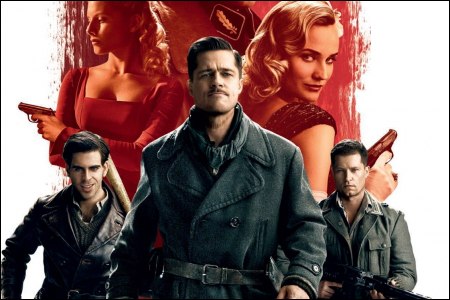
Spoilers Ahead. Serious Spoilers.
Quentin Tarantino’s new film, Inglourious Basterds, is about a lot of different things. On the surface, Basterds is a simple World War II-era story in which a band of Jewish-American soldiers travel into Nazi-occupied France in order to kill (and scalp!) as many Nazis as possible. Of course, when Tarantino is at the helm of such a plot, it can only be accompanied with brains bashed in with a baseball bat, shootouts, explosions, witty banter, a Mexican standoff, sexy women, and all of the director’s other trademarks.
But much more importantly, Inglourious Basterds is a film about film. About the subversion of film, to be more precise.
With that being said, it is worthwhile to first delve into the notion that Inglourious Basterds is actually an exploration of film itself. Conspicuously, many of the characters have various positions within the film industry; Shoshanna owns a cinema in Paris, Marcel helps maintain and operate said cinema, Frederick Zoller is a Nazi war hero starring in a biographical movie, German Minister of Propaganda Joseph Goebbels is tasked with producing this movie, and German actress Bridget von Hammersmark is a double-agent working for the British. As these pivotal characters play a number of different (yet equally important) roles, Inglorious Basterds suggests that the consciousness of film is stocked with varying strains of the human condition.
More pragmatically, Inglourious Basterds’ advocacy on the behalf of film can be found in its plot. While the trailers and taglines are advertising the fact that the movie features a bunch of Jewish-Americans killing Nazis, they neglect to mention that the Basterds’ true aim is to assassinate several hundred top Nazi officials (including Hitler himself); conveniently (or is it thematically?), these officials are all going to be gathered together at Shoshanna’s cinema for the premiere of A Nation’s Pride, Goebbels’ newest piece of propaganda. Resultingly, the Basterds spend a good deal of their inglorious adventures trying to figure out how to get into the premiere so that their primary task can be completed. By centering his newest work on the idea that a movie theater can be the single most important place on Earth, Tarantino effectively demonstrates the power and magnitude of film.
Thirdly, Inglourious Basterds works as a sort of self-aware investigation of film through much of its overt exposition. The name-dropping of (ostensibly classic) foreign language films, actors/actresses, and directors becomes so ubiquitous that I began to sense myself tuning them out — every character seems to get a chance to talk about movies at one point or another. Even less subtle is the brief narrative pause in which a Samuel L. Jackson voice-over presents an anecdotal history of 35mm’s more explosive qualities. And although this segment is well-done and wholly entertaining, other (less obvious) narrative devices could have been employed in order to convey the same information. But by deftly incorporating references to the film industry and even the literal film itself, Inglourious Basterds manages to keep the forefront of the audience’s mind more consciously concerned with movies.
So yes, it is obvious to even the least astute viewers that film may be the very crux of Inglourious Basterds. More interestingly, though, is the idea that Tarantino is commenting on cinematic subversion, an act to which he is no stranger. The spirit of subversion, of challenging the power structure at large in the hopes of building anew, is embodied in the plans of Shoshanna & Marcel.
Shoshanna conceives of a strategy with which she can effectively destroy the oppressive regime under which she has lived & avenge the death of her family; she allows the Nazis to premiere their newest propaganda film at her cinema so that she can:
A) Splice in footage of her own anti-Nazi sentiments.
B) Lock the doors and burn down the entire theater, killing her enemies in the process.
Furthermore, Shoshanna convinces Marcel that her collection of (highly flammable) 35mm films will be more than suitable to fuel the fatal fire.
The plan goes off (albeit not without a hitch or two), and Inglourious Basterds ends by revealing itself to be a sort of alternate-universe version of World War II, in which the Americans win in 1944. Therefore, the viewer is left with the impression that the subversion of film (the claiming for one’s own that by which he/she has been oppressed) can lead to the defeat of the most tyrannical of forces.
To reiterate, Shoshanna and Marcel take the weapon of the ruling power (film) and use it for their own purpose, which just so happens to be counter to that of those wielding the weapon in the first place. Playing to a crowd of shocked/confused/disgusted Nazis, Shoshanna’s filmed message instructs Marcel to burn it down, prompting him to flick his cigarette into the 35mm collection. This act is especially incendiary because it is brought about by two minorities (a Jew in hiding and a black Frenchman during the occupation), and there is something resonant in the idea that scourge of an oppressive regime can bring about its demise. And although the literal result of burning the evil Nazi crime lords to death is an amazing scene, its figurative implications are far more fulfilling.
In a sense, what Tarantino seems to be advocating is not for blanket imitation or pastiche; instead, he believes that the forms of yesteryear can be manipulated in such a way as to become new entities altogether – thereby allowing for the possibility of resisting the structure as it originally stood. Tarantino has always taken bits of pieces from various sources (spaghetti westerns, art house, grindhouse, Blaxploitation, kung-fu, etc., etc.) and added them together with new elements as to create original pieces that incorporate some previously established elements that have stood the tests of time.
Maybe I’m going on a limb here, but I can’t help but feel as though Inglourious Basterds is more than just an old-fashioned Nazi-killing jamboree. It’s about the power of narrative, the persuasive force that is propaganda, and the hope & possibility granted to those who defy the standards by reworking the supposedly predetermined into something liberating and novel.
In any case, I’m really digging Inglourious Basterds — all I have done since watching it tonight was ponder these (Insightful? Ridiculous? Misguided?) ideas and attempt to sling them into my word processor. It’s almost 4 AM and all I want to do is see the movie again. Too bad I have to do some other stupid shit first, like edit these two pages and then go to sleep.
Bah!