

#Space
Spying On The Mars Opportunity Rover From Space!
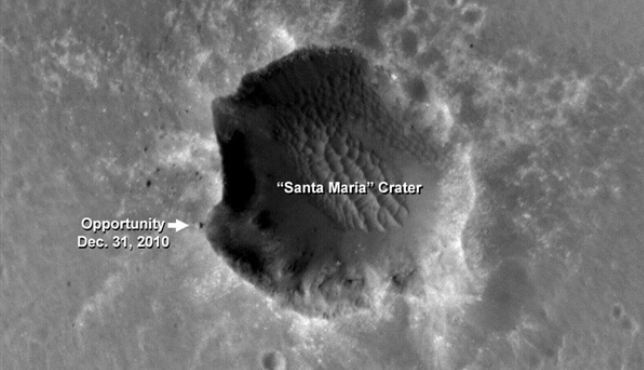
Watch the fuck out! That’s the Mars Opportunity rover rolling up on a crater. Don’t do it! Life’s worth living! This picture is pretty awesome. It’s of a piece of technology we placed down to explore an alien world being seen by another piece of technology we jettisoned into space and traveled 35-million miles.
Righteous.
Via.
No Comments
This Is The Milky Way Galaxy’s Big Brother
[Enlarge.]
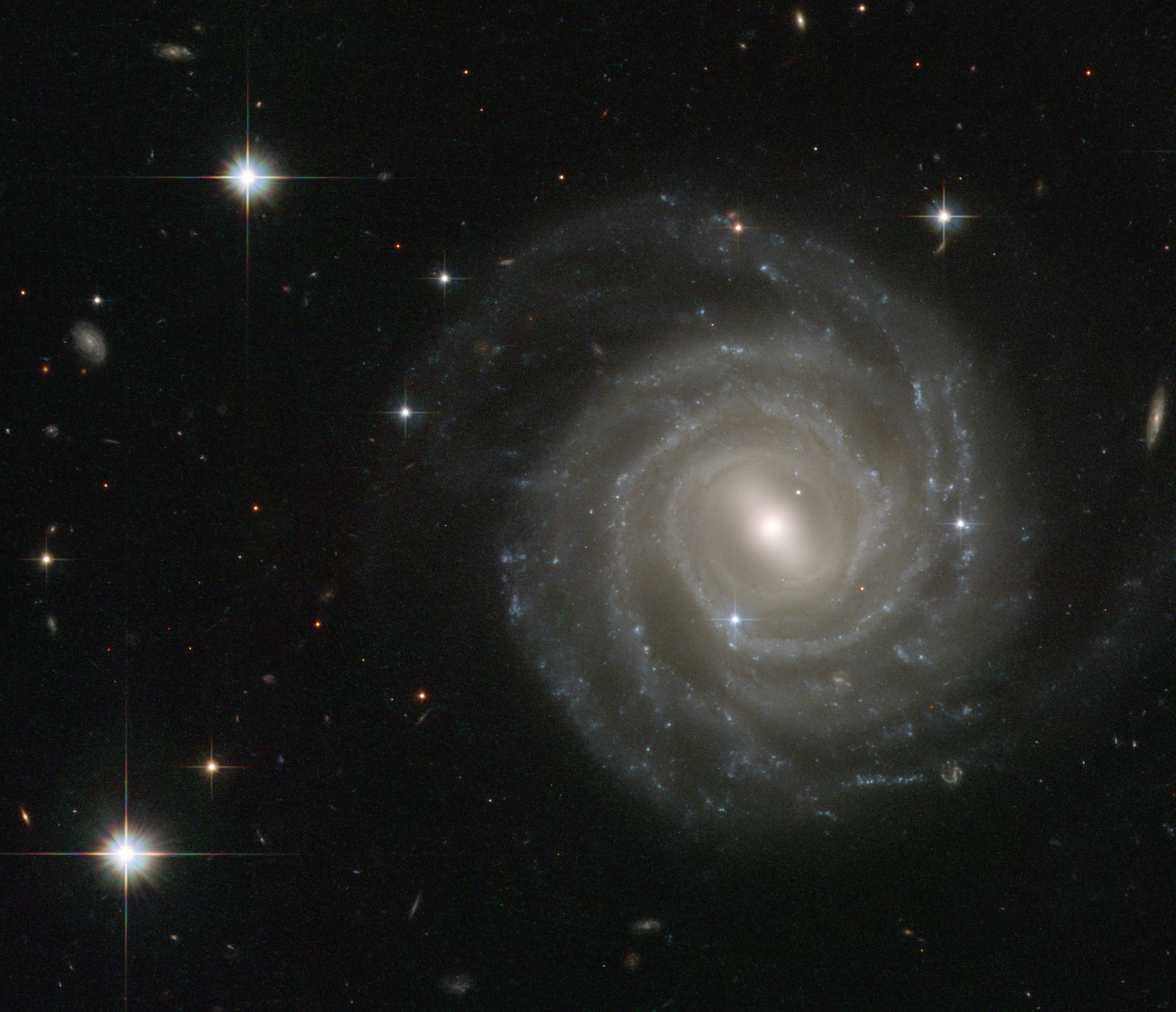
Meet UGC 12158. Or as he calls himself in bars to pick up chicks, Biggie Spiral. You’ll notice a resemblance between Biggie and our favorite galaxy: Sir Milky Way. Namely, that they’re both gorgeous spiral galaxies. Phil Plait, who has worked with Hubble images for years, decided to crunch the numbers on this gorgeous galaxy:
So I went to the release page for it, and when I saw the distance, I was shocked: that galaxy’s not big, it’s freaking huge. I figured it was part of the Virgo cluster, maybe, 60 million light years away or so. Nope: it’s a whopping 400 million light years distant, which is a long, long haul. That was stunning to me; if it’s that far away the galaxy really has to be a bruiser. So I grabbed a raw image from the Hubble archive and measured its size in pixels, which I could then convert to a spatial size given its distance.
And I can still hardly accept this, but UGC 12158 is 140,000 light years across. I measured it twice, two different ways, to be sure. That’s the biggest spiral I’ve ever heard of! Mind you, the Milky Way is in the top tier of galaxies in the entire Universe when it comes to size, but UGC 12158 whips us by a clean 40%!.
Good lord. I had no idea that the Milky Way Galaxy was an impressively sized galaxy until Phil Plait dropped that knowledge bomb on me. But still!, this galaxy is 40% bigger? Brain. Doesn’t compute. Wants to, but cannot.
Via.
Behold The Andromeda Galaxy In Three Different Lights!
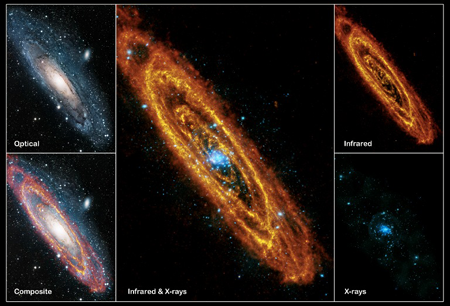
The Andromeda Galaxy is our boy. It’s the nearest spiral galaxy to us, and someday we’re going to collide with it. The good news is that we have some time to prepare for it, since it isn’t going to happen for another three to five billion years. Calm down. Sit down. We got time. Over at io9, they break down a gallery recently done by the European Space Agency. The ESA created the gallery by using “three different kinds of light: visible, infrared, and x-ray. These three very different views are then combined together to create one amazingly beautiful composite image.”
Want to see the images? Hit the jump.
Double Solar Eclipse? What Does This Mean!
[Enlarge.]
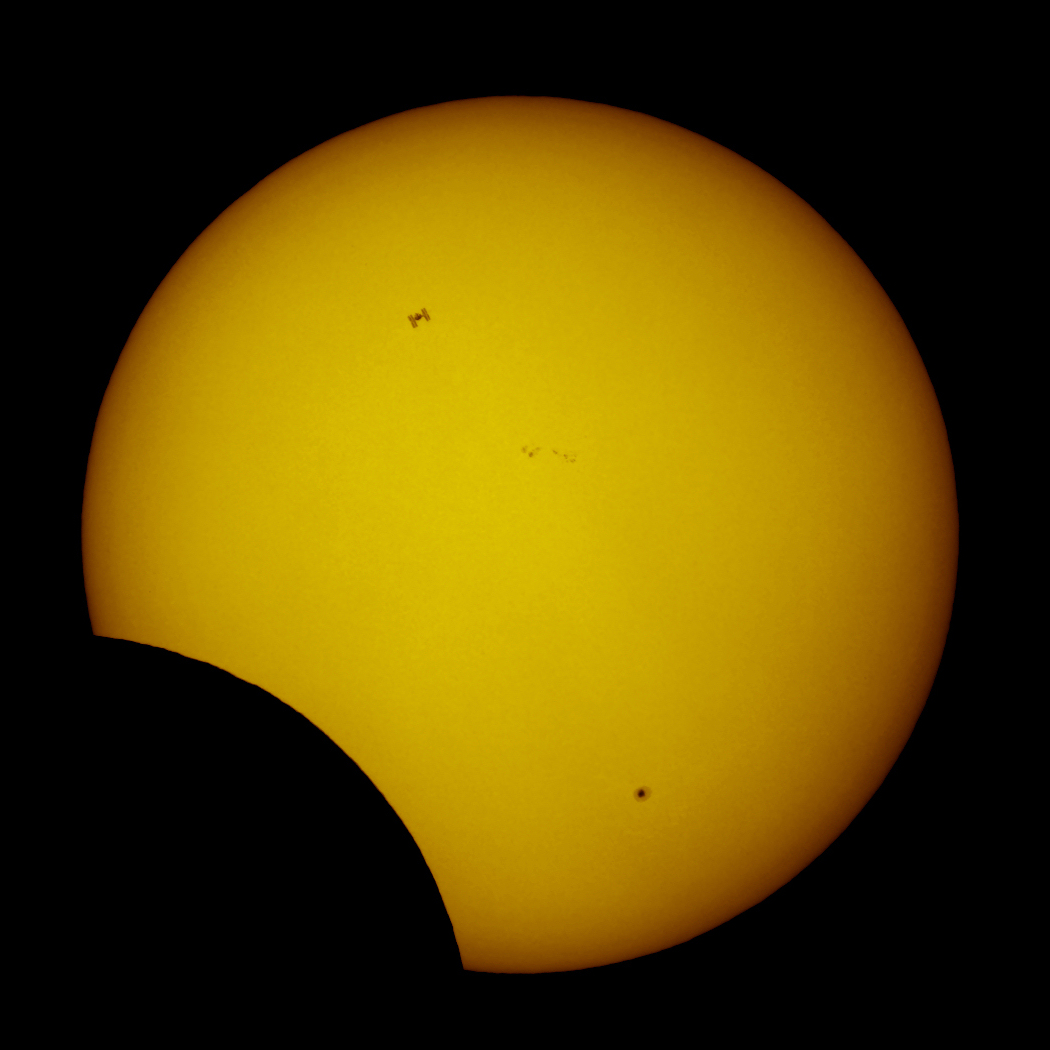
Today, Bad Astronomy linked to this picture by Thierry Legault. Not only is it gorgeous, but it’s a bit special. Why? It’s a friggin’ double eclipse! Wait, wut you ask? Phil Plait over at the aforementioned site breaks it down in ways that I can only fathom.
Can you see why he traveled so far to get this shot? The silhouette of the Moon taking a dark bite out of the Sun is obvious enough, as are some interesting sunspots on the Sun’s face… but wait a sec… that one spot isn’t a spot at all, it’s the International Space Station! This was a double eclipse!
That’s why Thierry sojourned to Oman; due to the geometry of the ISS orbit, it was from there that he had the best chance of getting a picture of the station as it passed in front of the Sun during the relatively brief duration of the actual solar eclipse. But talk about brief; the ISS was in front of the Sun for less than second, so not only did he have one chance at getting this spectacular once-in-a-lifetime shot, but he had only a fraction of a second to snap it!
To give you an overall idea of what you’re seeing here: the Sun is 147 million kilometers away (less than usual because this eclipse happened, coincidentally, very close to perihelion, when Earth was closest to the Sun). The Moon is 390,000 kilometers away. The Sun is about 400 times bigger than the Moon, but also about 400 times farther away, making them look about the same size in the sky. If you’re still having a hard time picturing the scale, take a look at the dark sunspot in the lower right of the big picture: it’s about twice the size of the Earth!
Like I said, Plait is amazing. This image is already incredible, but then he goes and gives it even more scope. The dark sunspot is twice the size of Earth? Incredible. In the truest sense of the word.
Solar Eclipse Brings Death Star To Earth!
[Enlarge.]
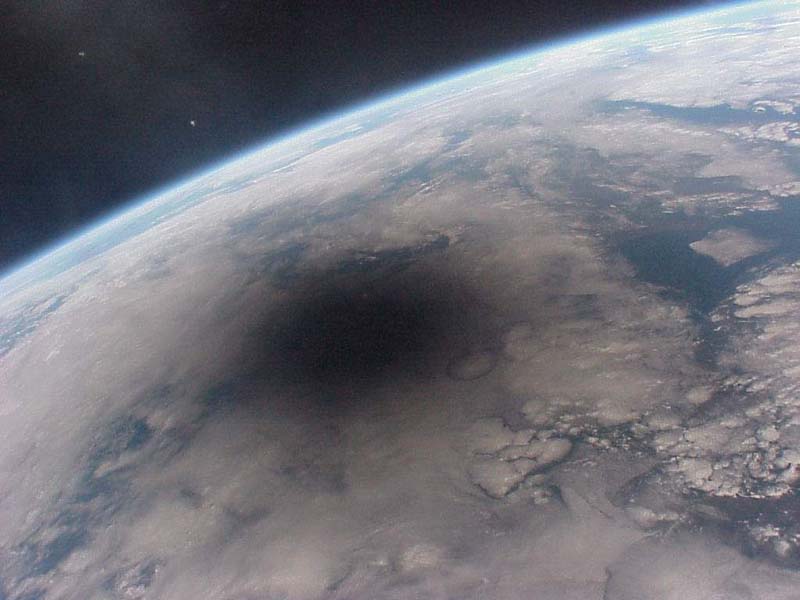
Since I’m a life long geek, everything is filtered through Star Wars and video game metaphors. So when I saw this picture of a solar eclipse taken by the Mir space station in 1999, all I could think was the daunting shadow of the most famous planet obliterator. Earth about to go Alderaan!
Saturn’s Great White Spot Is A Thousand-Mile Storm. Spacesplooge.
[Enlarge.]
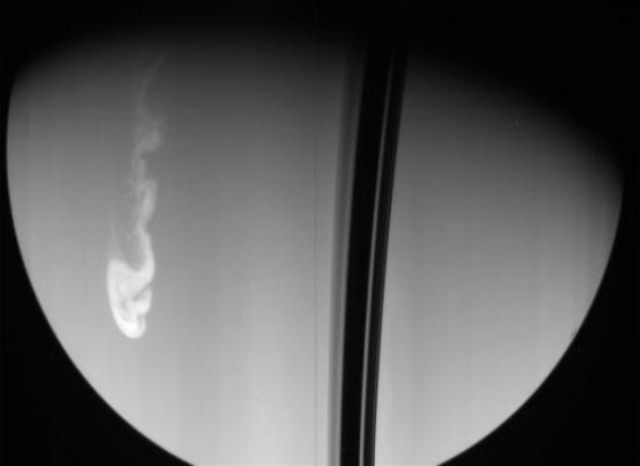
Everyone knows about Jupiter’s Red Spot. And for good reason, ’cause it’s goddamn impressive. But did you know that Saturn has its own friggin’ insane spot? Not to be outdone by its solar system brethren, Saturn has a Great White Spot that is a thousand-mile storm.
The Great White Spot is the lesser known, Saturnian equivalent of Jupiter’s Great Red Spot. It’s the name given to periodic storms that flare up about every 28.5 years, previously showing up in 1876, 1903, 1933, 1960, and 1990. As such, we shouldn’t be expecting another appearance until around 2018, although huge, Spot-like storms do occasionally show up at times that don’t fit the cycle, including 1994 and 2006.
G’damn! Thanks to a new image by the Cassini probe taken on Christmas Eve, we may have an insane image of another occurrence:
torms like these are thought to be created by thermal instability, which throws up tons of material from the planet’s lower atmosphere up into the higher regions. When these storms overlap with the turning of Saturn’s seasonal cycle every 28 or so years, the storm becomes so massive that it can encircle the entire planet, creating the Great White Spot.
[cont]
Technically speaking, we don’t know yet whether this particular storm will develop into a full-fledged Great White Spot. Of course, even if it doesn’t technically qualify for “great” status, we’re still talking about a storm system that you could fit this week’s northeastern blizzard into a dozen times over.
If that shit isn’t mindblowing enough, Bad Astronomy puts it into even crazier perspective:
This image, taken with a blue filter, shows the storm clearly. The main spot is huge, about 6,000 km (3600 miles) across – half the size of Earth! Including the tail streaming off to the right, the whole system is over 60,000 km (36,000 miles) long.
Whether this is a new iteration of the son of a bitch Great White Spot, or just an enormous storm enough to send me into a full-blown existential crisis, it’s goddamn gorgeous.
Monday Morning Commute: Twain. Skye. Lime.

Come one, come all! Join the frenzy! This is the Monday Morning Commute, the little niche I carve for myself at the beginning of the work week to tell you about my tentative plans for the next few days. After you read about the nerdcore endeavors I’ll be undertaking, hit the comments section with your own course(s) of action.
Are you going to spend every night drankin’ beers and reading Lord of the Rings? Are you going to finally apologize to the mailman for assaulting him during a caffeinated rage of blinding proportions? Are you going meet your Internet girlfriend at a shady bowling alley? Let us know.
But for now, take a peek at what I’ll be doing.
Milky Way Moves Through The Night Sky In Time Lapse. [Video.]
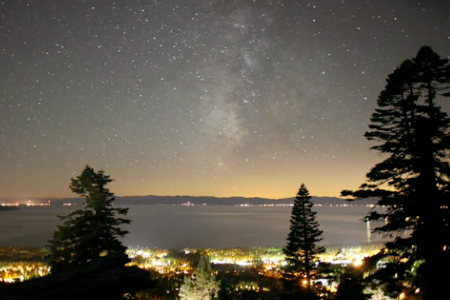
In September, Justin Majeczsky caught the Milky Way moving through the night sky. What a gorgeous time lapse video. A sexy reminder that we are currently nestled within a galaxy floating through space. The universe churns around us. Through us. Phil Plait at Bad Astronomy (a blog of incalculable awesomeness), puts it in crazier perspective:
From our vantage point 25,000 light years or so out, you can see the central bulge of the galaxy moving across the sky. That’s the combined might of billions of stars and octillions of tons of gas and dust!
It’s absolutely fucking mind blowing. My fat simian mind attempting to comprehend it, fails. Fails hard. Imagine if there’s life on other planets, can you imagine how fucking tired Santa Claus must be? Hit the jump for the video.
More Lunar Eclipse Space Porn!
[Enlarge.]
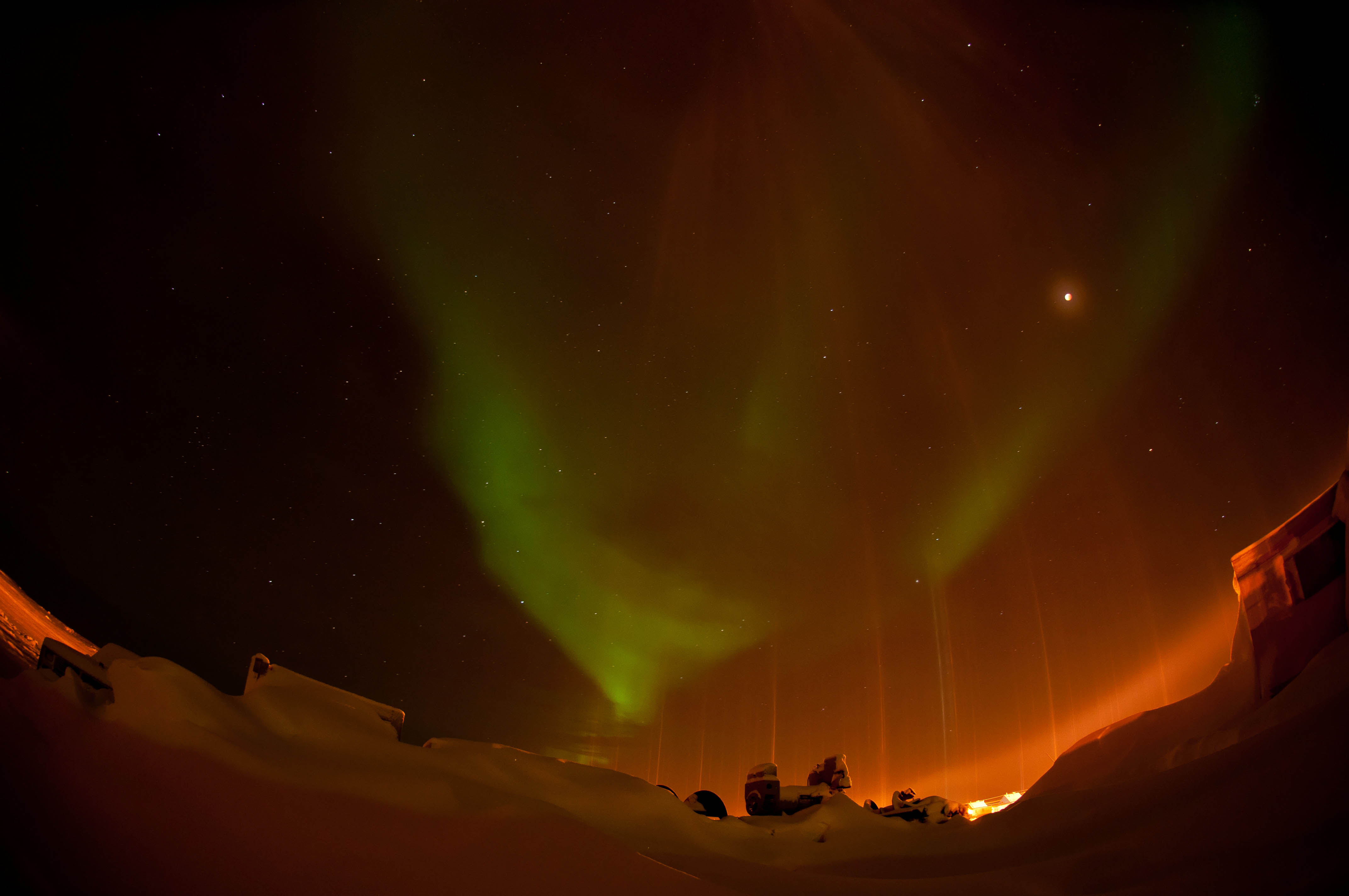
Today, Bad Astronomy posted this picture of the Lunar Eclipse by Francis Anderson. What exactly is causing the gorgeous effect? Phil Plait over at BA explains:
[The picture was taken at] a small town located at the bone-chilling latitude of 69 ° north, inside the Arctic Circle. That explains the visibility of the gorgeous aurora borealis, the glow from solar subatomic particles as they slam into our atmosphere. Guided by the Earth’s magnetic field to the geomagnetic poles near the north and south geographic poles, these particles shear electrons off the molecules and atoms of air, causing it to glow.”
Outstanding. For more on the picture, including what is causing those columns of light, hit up Bad Astronomy.