


#Rendar Frankenstein
Cudi Isn’t Kiddin’

Kid Cudi is mainstream hip hop’s next potential savior.
Ok, let me step back and add a preface — I’m a twenty-two year old, white & nerdy (-6 points for the Weird Al reference) suburbanite who grew up listening to metal and drumming in a prog-metal band. With that being said, I truly believe that Kid Cudi is going to be next great, worthwhile hip hop act.
“Well, Pepsibones, what makes you think that?”
Well, three key points (which, for my sake, can be conveniently listed) stand out:
1) Exposure — This dude is getting pushed hardcore. As I said, I generally keep my ear turned to the harder hitting scenes/bands. And yet, I can’t help but hear about the sickness that is Kid Cudi. Between the Day’n’Nite single receiving continuous (or is that incessant?) radio play and features such as that in last month’s Spin, Cudi seems to be sneaking into the (pop) cultural consciousness. I mean, fuck, when I loaded up OL today the guy popped into the banner at the top and said hello to me.
In short, Kid Cudi is getting the media push needed to help hip hop. Don’t misunderstand me, I’m sure there are plenty of better (whatever that means) underground rappers — but without the exposure their words aren’t going to reach the masses. While I might have hoped for last year’s Esoteric vs. Japan: Pterodactyl Takes Tokyo! to have received more attention, I wasn’t surprised when it didn’t blow up and change the game; the exposure just wasn’t there. With Kid Cudi, it is.
2) Stylistic Plurality — When I subject myself to the radio or MTV, I usually find myself balking like the old man on the block, “Bah! All this rubbish sounds the same!” In the era of five-second ringtone hooks and a reliance on autotuner that makes Kirk Hammett’s wah-pedal use look like occasional experimentation, anything that breaks the mold is greatly appreciated. Not only does Kid Cudi bring a different, more earnest perspective, he presents it a number of different ways.
The A Kid Named Cudi mixtape features mellow, introspective numbers like 50 Ways to Make a Record & Man on the Moon (which shares its name with Cudi’s full-length), the danceable stoner’s love song that is Maui Wowie, a couple of more freestyle-feeling showcases such as Cudi Spazzin’, and hometown anthem Cleveland is the Reason (it is shocking that I’ve yet to see this track supporting a montage of King James dunks).
If Man on the Moon makes use of even half of the styles found on Cudi’s breakthrough mixtape, we’re all in for a treat. Again, between the exposure and success of Day’n’Nite, the people are already going to give his shit a chance — and when they see that he offers something for everyone, they’ll be hooked.
3) Inspiring Kanye to Stop Sucking – Up until November 2008, Kanye West was a hero of mine. In spite of the fact that he is one of the most arrogant pop culture figures of recent history, I couldn’t help but love the guy. Every interview and appearance found him talking all sorts of crazy shit, but I would just laugh it off, preferring to bob my head rather than shake it.
Maybe it was the fact that at his best, Kanye managed to truly inspire me to look past the preconceived paths laid before me and carve my own way through the brush of life.
[Good Morning]
Look at the valedictorian scared of the future
While I hop in the Delorean.
Scared-to-face-the-world complacent career student,
Some people graduate, but be still stupid.
They tell you read this, eat this, don’t look around…
For a time, even Kanye’s most heedless lyrics were awesome in their own ridiculous, hilarious way.
[New Workout Plan]
1 and 2 and 3 and 4 and get them sit-ups right &
Tuck your tummy tight & do your crunches like this;
Give head, stop breathe, get up, check your weave
Don’t drop the blunt and disrespect the weed.
Yes, it’s hard to defend such songs as having any sort of deep literary merit, but they made me smile & laugh, and that certainly counts in my book.
But then Kanye broke up with a girl and lost his mind. Or something. The result: the dismal 808’s & Heartbreak which contains neither the mindful insights of personal empowerment nor humorous musings about girls and weed and drinking and all that other awesome shit. No, all that 808’s provides is autotuned ramblings about lamenting love.
[Coldest Winter]
Goodbye my friend will I ever love again?
Goodbye my friend will I ever love again?
Goodbye my friend will I ever love again?
Goodbye my friend will I ever love again?
Brilliant. And for those apologists that claim “It’s a heartfelt track about love!” I offer two counterpoints: 1) How heartfelt and raw can words be when processed until they sound like a robot? 2) Just because something is heartfelt doesn’t mean it’s any good.
But now we have Kid Cudi, carrying with him the inspiration to restore Kanye West to his former (admittedly arguable) greatness. Kanye enlisted Cudi to help him with 808’s & Heartbreak and the product was the slightly less reprehensible Welcome to Heartbreak. Since then, Kanye has dedicated himself to crafting tracks for Kid Cudi’s debut, including the reworking of Lady Gaga’s Poker Face into the much more overt lauding of oral sex that is Make Her Say. West even went as far as to contribute a verse, returning to his old jovial, fun-loving form in the process. Again, it may not be mentally dazzling, but even being entertaining is an improvement at this point.
Sure, the idea of Kid Cudi helping elevate Kanye back up to the plateau he once reached is wishful thinking. But even if this doesn’t become reality, Cudi’s good enough on his own to make a long lasting impression on the mainstream rap world that is, in my opinion, suffering from the fatigue of thematic repetition. Mark my words, Kid Cudi’s Man on the Moon is going to be the relevant rap album of 2009.
That is, of course, until Lupe Fiasco puts out Lasers in December.
4 Comments »
Quentin Tarantino is a Subversive Basterd
Spoilers Ahead. Serious Spoilers.
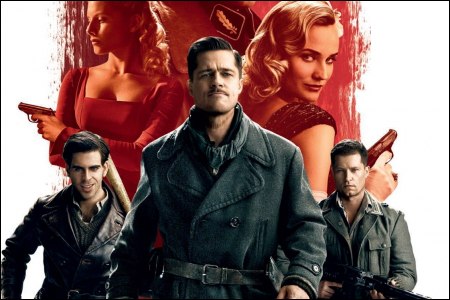
Quentin Tarantino’s new film, Inglourious Basterds, is about a lot of different things. On the surface, Basterds is a simple World War II-era story in which a band of Jewish-American soldiers travel into Nazi-occupied France in order to kill (and scalp!) as many Nazis as possible. Of course, when Tarantino is at the helm of such a plot, it can only be accompanied with brains bashed in with a baseball bat, shootouts, explosions, witty banter, a Mexican standoff, sexy women, and all of the director’s other trademarks.
But much more importantly, Inglourious Basterds is a film about film. About the subversion of film, to be more precise.
With that being said, it is worthwhile to first delve into the notion that Inglourious Basterds is actually an exploration of film itself. Conspicuously, many of the characters have various positions within the film industry; Shoshanna owns a cinema in Paris, Marcel helps maintain and operate said cinema, Frederick Zoller is a Nazi war hero starring in a biographical movie, German Minister of Propaganda Joseph Goebbels is tasked with producing this movie, and German actress Bridget von Hammersmark is a double-agent working for the British. As these pivotal characters play a number of different (yet equally important) roles, Inglorious Basterds suggests that the consciousness of film is stocked with varying strains of the human condition.
More pragmatically, Inglourious Basterds’ advocacy on the behalf of film can be found in its plot. While the trailers and taglines are advertising the fact that the movie features a bunch of Jewish-Americans killing Nazis, they neglect to mention that the Basterds’ true aim is to assassinate several hundred top Nazi officials (including Hitler himself); conveniently (or is it thematically?), these officials are all going to be gathered together at Shoshanna’s cinema for the premiere of A Nation’s Pride, Goebbels’ newest piece of propaganda. Resultingly, the Basterds spend a good deal of their inglorious adventures trying to figure out how to get into the premiere so that their primary task can be completed. By centering his newest work on the idea that a movie theater can be the single most important place on Earth, Tarantino effectively demonstrates the power and magnitude of film.
Thirdly, Inglourious Basterds works as a sort of self-aware investigation of film through much of its overt exposition. The name-dropping of (ostensibly classic) foreign language films, actors/actresses, and directors becomes so ubiquitous that I began to sense myself tuning them out — every character seems to get a chance to talk about movies at one point or another. Even less subtle is the brief narrative pause in which a Samuel L. Jackson voice-over presents an anecdotal history of 35mm’s more explosive qualities. And although this segment is well-done and wholly entertaining, other (less obvious) narrative devices could have been employed in order to convey the same information. But by deftly incorporating references to the film industry and even the literal film itself, Inglourious Basterds manages to keep the forefront of the audience’s mind more consciously concerned with movies.
So yes, it is obvious to even the least astute viewers that film may be the very crux of Inglourious Basterds. More interestingly, though, is the idea that Tarantino is commenting on cinematic subversion, an act to which he is no stranger. The spirit of subversion, of challenging the power structure at large in the hopes of building anew, is embodied in the plans of Shoshanna & Marcel.
Shoshanna conceives of a strategy with which she can effectively destroy the oppressive regime under which she has lived & avenge the death of her family; she allows the Nazis to premiere their newest propaganda film at her cinema so that she can:
A) Splice in footage of her own anti-Nazi sentiments.
B) Lock the doors and burn down the entire theater, killing her enemies in the process.
Furthermore, Shoshanna convinces Marcel that her collection of (highly flammable) 35mm films will be more than suitable to fuel the fatal fire.
The plan goes off (albeit not without a hitch or two), and Inglourious Basterds ends by revealing itself to be a sort of alternate-universe version of World War II, in which the Americans win in 1944. Therefore, the viewer is left with the impression that the subversion of film (the claiming for one’s own that by which he/she has been oppressed) can lead to the defeat of the most tyrannical of forces.
To reiterate, Shoshanna and Marcel take the weapon of the ruling power (film) and use it for their own purpose, which just so happens to be counter to that of those wielding the weapon in the first place. Playing to a crowd of shocked/confused/disgusted Nazis, Shoshanna’s filmed message instructs Marcel to burn it down, prompting him to flick his cigarette into the 35mm collection. This act is especially incendiary because it is brought about by two minorities (a Jew in hiding and a black Frenchman during the occupation), and there is something resonant in the idea that scourge of an oppressive regime can bring about its demise. And although the literal result of burning the evil Nazi crime lords to death is an amazing scene, its figurative implications are far more fulfilling.
In a sense, what Tarantino seems to be advocating is not for blanket imitation or pastiche; instead, he believes that the forms of yesteryear can be manipulated in such a way as to become new entities altogether – thereby allowing for the possibility of resisting the structure as it originally stood. Tarantino has always taken bits of pieces from various sources (spaghetti westerns, art house, grindhouse, Blaxploitation, kung-fu, etc., etc.) and added them together with new elements as to create original pieces that incorporate some previously established elements that have stood the tests of time.
Maybe I’m going on a limb here, but I can’t help but feel as though Inglourious Basterds is more than just an old-fashioned Nazi-killing jamboree. It’s about the power of narrative, the persuasive force that is propaganda, and the hope & possibility granted to those who defy the standards by reworking the supposedly predetermined into something liberating and novel.
In any case, I’m really digging Inglourious Basterds — all I have done since watching it tonight was ponder these (Insightful? Ridiculous? Misguided?) ideas and attempt to sling them into my word processor. It’s almost 4 AM and all I want to do is see the movie again. Too bad I have to do some other stupid shit first, like edit these two pages and then go to sleep.
Bah!