



#February2011
Kepler Telescope Has Discovered 1,000+ Planets. Good Lord.

You can’t seem to go a week or two these days without some ridiculous news coming out regarding the Kepler telescope. The son of a bitch has been in orbit for something like two years, and the intrepid son of a bitch just keeps finding planets. It’s a planet finding motherfucker. Today it was dropped that Kepler has found in excess of 1,200 possible planets.
Read the rest of this entry »
No Comments
We’re Small: The Universe Is AT LEAST 250x Larger Than It Looks.
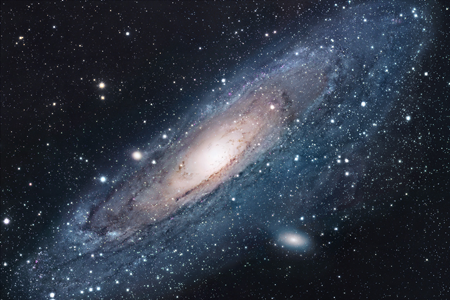
Alasdair Wilkins over at io9 has some existential nausea for you. The universe? Apparently it is at least 250 times larger than it looks. Does that make no sense to you? Yeah, me either. Until! Until some elucidation:
So just how far can we see into the visible universe? Since the universe is about 14 billion years old, it seems obvious that we can only see within the nearest 14 billion light-years. But that isn’t quite right, as cosmic expansion has expanded the distance between us and the most distant cosmic objects to as much as 45 billion light-years. That means that there’s just about 90 billion light-years worth of visible universe that we can see.
But even that can’t compare with the full size of the universe. Of course, if we can’t see part of the universe, then we can’t actually know anything about it, because no other information will have had time to reach us either. But the trick is that the structure of the universe we are able to see can reveal its overall size. Basically, the universe can have one of three structures: a closed shape like a sphere, a flat shape, or a completely open one. Either of the last two would mean the universe is infinite, but a closed spherical shape would mean the universe has a definite volume.
[cont]
…here’s what they found – in all likelihood, the universe is flat, which means it has an infinite size. But if it is a closed sphere, then we have a lower limit for its size, which is about 250 times the size of our visible universe. Obviously, 250 times to infinite is a pretty big range, but it’s by far the tightest constraints ever put forward, and having an actual lower limit for the universe’s size could prove hugely useful in other areas of cosmology.
The nausea! The nausea.
Awesome Existential Nausea: What If Jupiter And Others Were As Close As The Moon?
Brad Goodspeed has answered the question, “What the fuck would it look like if other planets in our solar system were as close to us as the Moon?” Dude did it in video form, and it’s sexy geek space porn. Goodspeed elaborates on his Vimeo page:
Here’s an animation I did to make you feel small, and also convey the deep awe I feel at the feet of the Universe.
While watching the video of the lunar eclipse I posted the other day I was looking at the curvature of the earth’s shadow on the moon. It made me think about how large the earth might look if an exact copy of it was up there instead of the moon. Soon curiosity got the better of me, and I was animating!So the basic idea is, each planet you see is the size it would appear in the sky if it shared an orbit with the moon, 380,000 kms from earth. I created this video in After Effects, and because of certain technical considerations had to keep the field of view at 62 degrees. That means the foreground element is not precisely to scale. I realized this after the fact and may update the video at some point in the future. All planets are to correct scale with one another in any case.
It’s gorgeous. Hit the jump to check it out.
This Galaxy Surfs The Edge of Space! Tubular!
Enlarge. | Via.
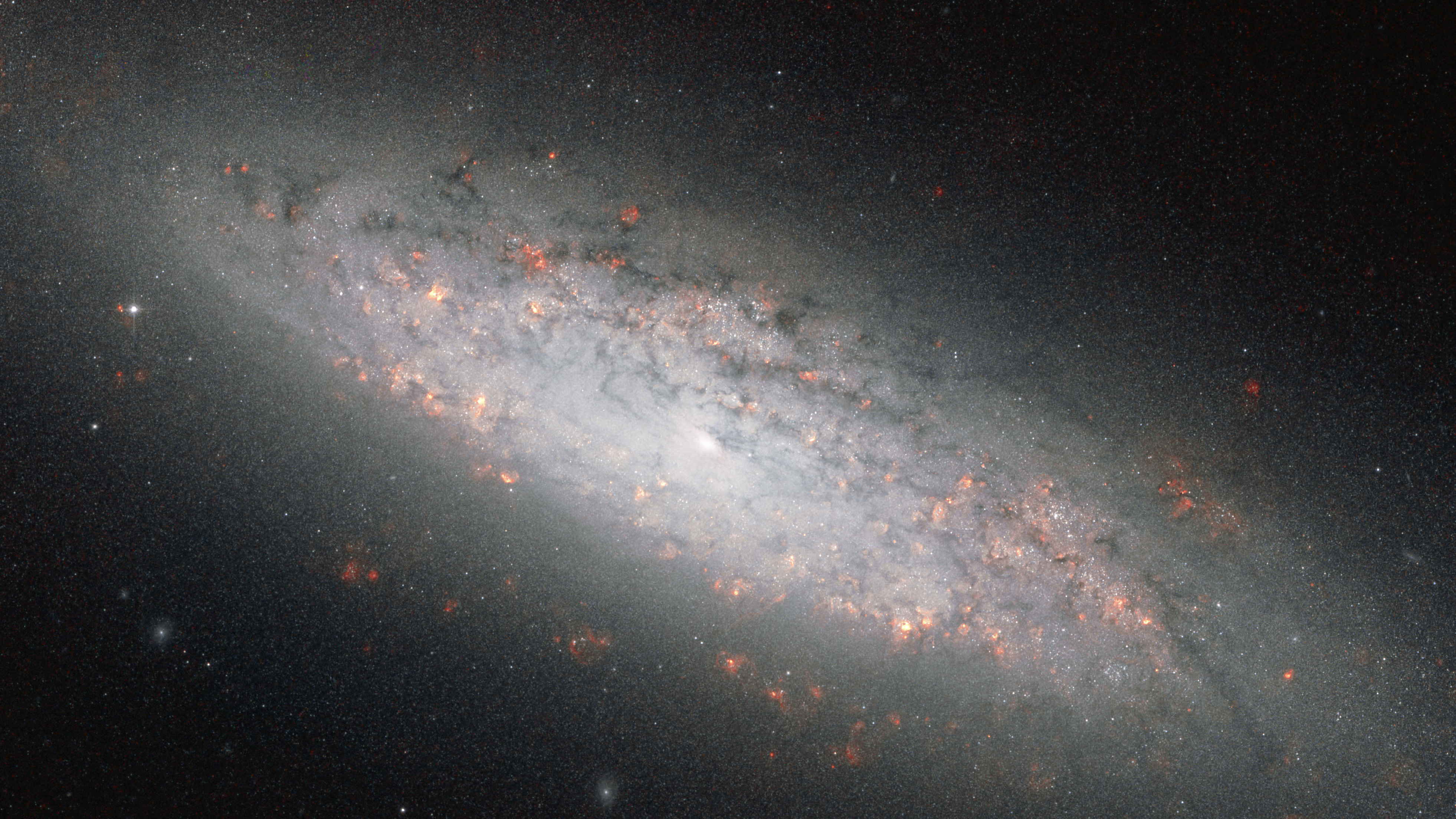
NGC 6503 is a righteous galaxy. A loner, if you will. It sits far outside of the Local Cluster of galaxies, hanging out in a galactic void.
Phil Plait with the deets:
It’s on the edge of the great local void: a vast region of space where galaxies are few and far between. Galaxies tend to exist in clusters and superclusters. The Milky Way is part of the the Local Group, a small collection of a few dozen galaxies which itself sits on the outskirts of the Virgo Cluster, 60 million light years away. In the opposite (more or less) direction, toward the constellation of Draco, is the Local Void. Our galaxy is near the edge of this void, but NGC 6503 is actually further into it, 17 million light years away from us. Even then, it’s only on the void’s edge; estimates vary but the empty region extends for something like 30 — 200 million light years in that direction!
So you can picture it: on one side of us is a collection of hundreds of galaxies in the Virgo cluster, which itself is part of a much larger supercluster containing thousands of galaxies. On the other side of us is an empty region of roughly the same size. Somehow, when the Universe itself was young, the matter in this region must have all condensed toward Virgo, leaving the void nearby. We think the entire Universe is this way, with dense regions of matter surrounding bubble-like voids. If you could step back and look, the Universe might appear like a giant sponge!
Outstanding! It’s hard to conceive of giant voids of space that are inconceivably large. NGC 6503 dares to go where uh, only intergalactic eagles dare! But it must watch out as it peers into the abyss. You know what Nietzsche said about the void! Careful if you peer into it, because if you do, you may die alone in an insane asylum or whatever.
I’m paraphrasing.
Strange Galaxy Is Turned Sideways; Leans Wit It, Rocks Wit It.
Enlarge. | Via.
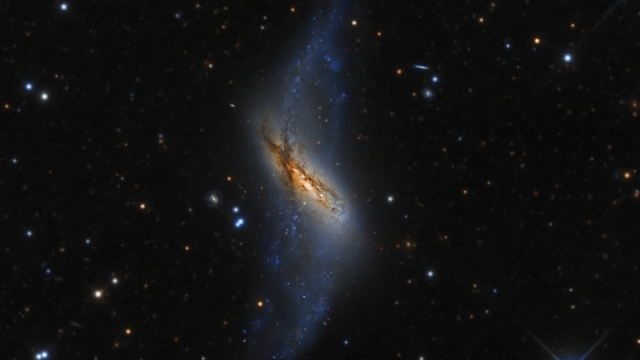
NGC 660 must be sippin’ sizzurp or whatever. It’s got some serious leaning going on with its galactic positioning. A sideways galaxy! What the fuck? Elucidation:
NGC 660 lies near the center of this intriguing skyscape, swimming in the boundaries of the constellation Pisces. Over 20 million light-years away, its peculiar appearance marks it as a polar ring galaxy. A rare galaxy type, polar ring galaxies have a substantial population of stars, gas, and dust orbiting in rings nearly perpendicular to the plane of the galactic disk. The bizarre configuration could have been caused by the chance capture of material from a passing galaxy by the disk galaxy, with the captured debris strung out in a rotating ring. The polar ring component can be used to explore the shape of the galaxy’s otherwise unseen dark matter halo by calculating the dark matter’s gravitational influence on the rotation of the ring and disk. Broader than the disk, NGC 660’s ring spans about 40,000 light-years.
Hey man, who am I to tell billions and billions of stars how to present themselves? A galaxy with a little swag? I’m feelin you, NGC 660. Feelin’ you.
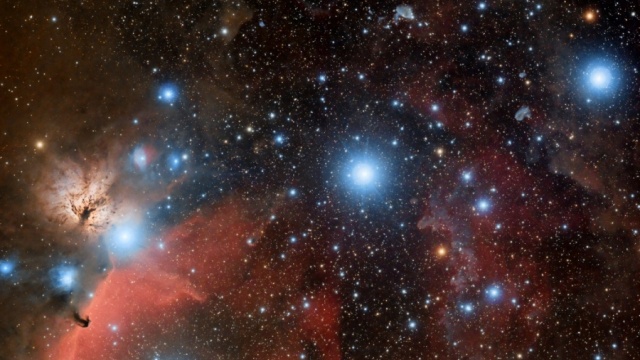
New Picture of Orion’s Belt Is Crazy, Sexy, Cool.
Enlarge. | Via.
This new picture of Orion’s Belt is fucking gorgeous. It’s all neat and stuff to stare into the sky and point out Orion’s Belt, but it’s even more dope when you deconstruct what it actually is:
This spectacular photo reveals the beauty of Alnitak, Alnilam, and Mintaka, the trio of stars that make up its belt.
This photo was taken last month and captures the three stars that make up Orion’s belt, arguably the most famous part of this particular constellation. The three bright blue stars are incredibly bright, although most of their luminosity is only found in the ultraviolet spectrum, so humans can’t fully appreciate just how unimaginably bright these stars really are.
Alnitak, the leftmost of the three stars, is about 100,000 times the brightness of the Sun when you factor in ultraviolet radiation, while the rightmost star Mintaka clocks in at 90,000 times. Technically, Mintaka isn’t actually a star at all, but rather two stars orbiting one another, but they’re so close together that they appear to be a single light source at our great distance away, which is thought to be about 1,000 light-years. Alnilam is the brightest of the three, with a luminosity 375,000 times that of the Sun.
Daily space porn. Hittin’ the quotient early for ya’ll, with a TLC reference to boot.
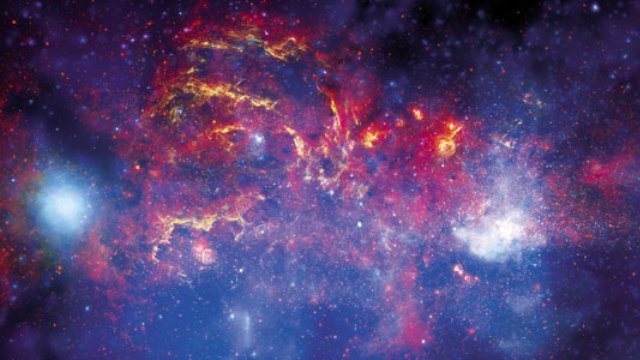
Behold The Center of the Milky Way Across The Entire Spectrum!
Enlarge. | Via.
See that shit? It’s the center of the galaxy you’re currently living in. Alasdair Wilkins explains how this pig was made:
This amazing image of the center of our galaxy is the work of three different space telescopes – Hubble, which photographs objects in the visual wavelengths, Chandra, which looks at X-rays, and Spitzer, which investigates the infrared.
Gorgeous. Astrophysicist Giovanni Fazio explains in Wilkin’s article that when ” you look at the universe in different wavelengths, you get a completely different picture. They are all pieces of a puzzle.” True dat.
Behold Megan Burns’ Space Babes In NYC.

Enlarge.
Up until yesterday, I hadn’t heard of Megan Burns. Thanks to the internets and io9, I am now educated. Knowledge has been acquired. Education implemented. Burns is an artist and is putting on a show this weekend in NYC that celebrates something everyone involved in Omega Level fucking loves: pin-up space babes art. You live in NYC, unlike me, and could actually check this awesomeness out? Here’s some deets:
Burns’ paintings will be featured alongside the neon alters of Pavel Kraus in “Ancient Sci-Fi Update,” at The Proposition, which is at 2 Extra Place on New York’s Lower East Side. The opening reception is today (Jan. 22) from 6 to 8 PM, and the show runs until Feb. 27.

Enlarge.
Go to the show. Go to her website. Show the love.
Earth May Be Getting A Second Sun. For A Bit.
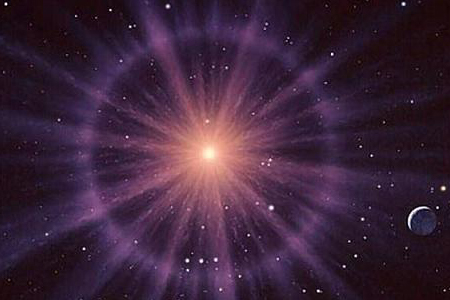
Betelgeuse is a pissed off red supergiant star. Soon, Betelgeuse is going to go supernova. According to Alasdair Wilkins in an article at io9, this is going to be particularly righteous for the citizens of Earth. You know, provided we’re alive and such.
The star is located in the Orion constellation, about 640 light-years away from Earth. It’s one of the bright and biggest stars in our galactic neighborhood – if you dropped it in our Solar System, it would extend all the way out to Jupiter, leaving Earth completely engulfed. In stellar terms, it’s predicted to explode in the very near future. Of course, the conversion from stellar to human terms is pretty extreme, as Betelgeuse is predicted to explode anytime in the next million years.
Out-fucking-standing. Notice the phrase “in stellar terms, it’s predicted to explode in the very near future.” I get the feeling we’re all going to be dead when it occurs. But wait, what is this going to look like?
But still, whether the explosion occurs in 2011 or 1002011 (give or take 640 years for the light to reach Earth), it’s going to make for one of the most unforgettable light shows in our planet’s history. For a few weeks, the supernova will be so bright that there will appear to be two stars in the sky, and night be will indistinguishable from day for much of that time. So don’t count on getting a lot of sleep when Betelgeuse explodes, because the only sensible thing for the world to do will be to throw a weeks-long global supernova party.
A few weeks of permanent daylight across the globe? This is fucking amazing. If you’re often wondering what the point of trudging along in your empty life, and you need a reason to live: stick it out for this.
Via.
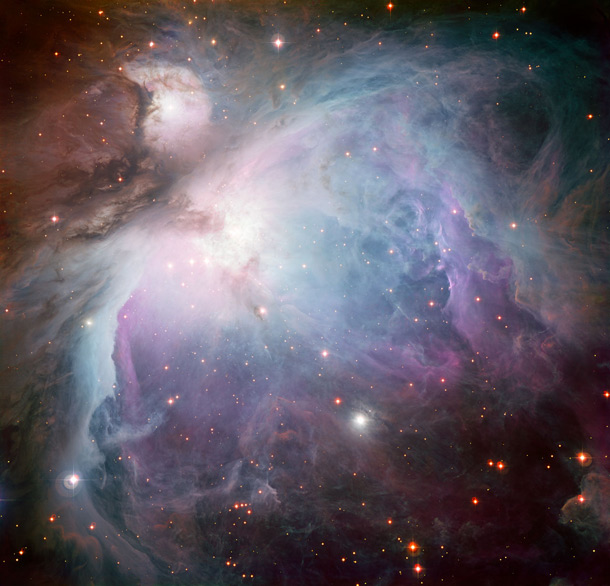
High-Res Shot Of Orion Nebula. Daily Space Porn.
Enlarge. | Super-High Res [142 Mb]. | Via.
Behold!, the Orion Nebula. If you haven’t clicked for the larger version, go, do it! The definition is ridiculous, no? This picture is staggering. As usual, Phil Plait at Bad Astronomy breaks down exactly what we’re looking at:
The nebula is a vast cloud of gas, both atomic and molecular, and dust located about 1350 light years away. It’s one of the largest star forming factories in the Milky Way, and what you see here is well over 20 light years across.
For years I figured it was just a diffuse glowing thing in space, but it turns out to be more complicated than that. In reality, a lot of the nebula is actually a dark, dense molecular cloud – literally, composed of molecules like H2 (molecular hydrogen) and CO (carbon monoxide). This cloud is actually far, far larger than what you see in this image, perhaps 20 times the width! But it’s dark, so we don’t see it in visible light… and what we’re seeing in this picture is not really a free-floating gas cloud, but a cavity in the wall of the denser dark cloud.
Stars are being born inside that cloud. Some of them are very massive, hot, and bright. They blast out a fierce stellar wind, like the solar wind but far more powerful. They also emit a fierce flood of ultraviolet photons. Together, these two forces erode away at the material of the cloud, breaking apart the molecules into their constituent atoms, ionizing them, and causing them to glow. It so happens that some of these stars were born near the side of this cloud, so when they ate away the insides of the cloud it caused a blister in the side which burst open.
You can actually see that in this image! The bulk of the colorful nebula, from the upper left on down, is actually gas inside this cavity set aglow. The far wall is opaque and dark, so you don’t see it here. But you can get a sense of the bubble-like nature of the nebula.
Outstanding. There’s your existential nausea for the day.