



#Space
Runaway Star Is Smashing Through The Cosmos!
Enlarge. | Via.
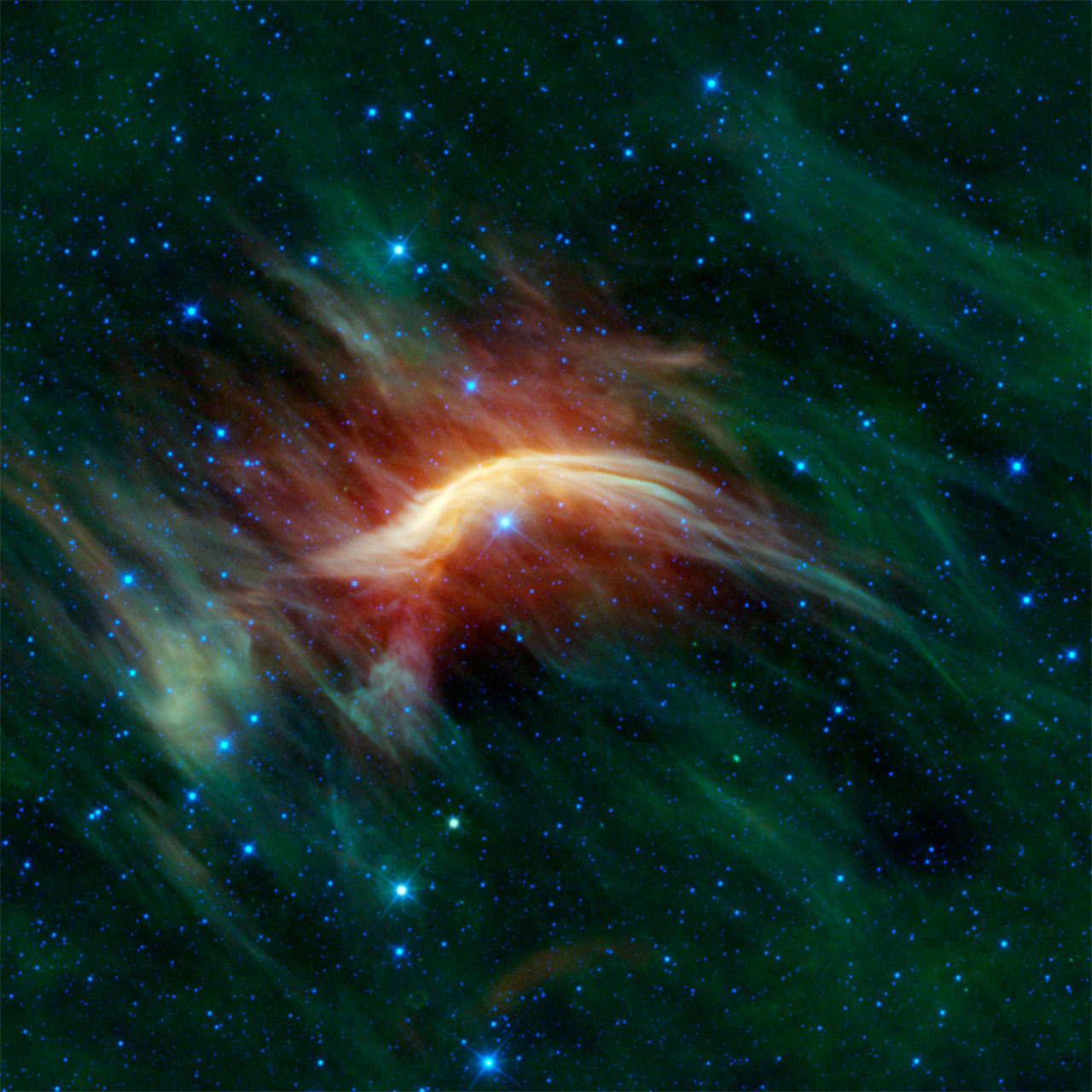
Behold Zeta Ophiuchi, a runaway star. Zeta is currently booking it through the cosmos, blasting through cosmic dust. What exactly is Zeta’s deal?
Bad Astronomy:
it’s a runaway star. It has a rather high speed compared to other stars, and we think we know why: it was once part of a binary system. It probably started off life with less mass, and it was orbiting a high mass star. The other star swelled up into a red supergiant, dumping vast amounts of material onto Zeta Oph. Then the star exploded as a supernova! When it did, it flung off Zeta Oph like a water droplet off a shaking dog. It wasn’t the explosion itself that pushed on the star; it was centripetal acceleration. The two stars were probably orbiting each other at high speed, and when the second star blew up, Zeta Oph kept that speed and flew off into space!
We see several such high-mass runaway stars, and we think that’s where they come from: they survived their partners going supernova.
But what the heck is all that stuff around it in the picture? WISE “sees” in infrared light, which is emitted by warm material like all that interstellar dust around Zeta Oph (which itself looks blue in this picture, but remember, it’s false color, even if Zeta Oph coincidentally really is blue). Most of that dust appears green in the image. But nearer the star that dust is considerably brighter for two reasons. One is that the material is being heated by the star itself as it passes through. But also there’s a fierce wind of material streaming off of Zeta Oph’s surface, and that’s ramming the dust, compressing it. Denser material, in this case, can glow more brightly than the thinner material around it.
Man! When my partner goes supernova, she generally drops a couple of karate chops on me and kicks me out of her apartment for the evening. Zeta got flung out of its friggin’ place in the universe.
1 Comment »
New Picture of Orion’s Belt Is Crazy, Sexy, Cool.
Enlarge. | Via.
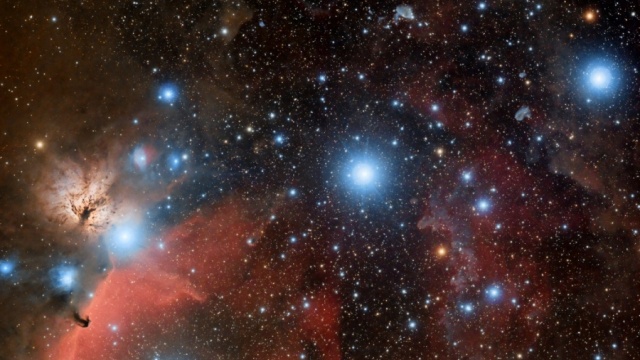
This new picture of Orion’s Belt is fucking gorgeous. It’s all neat and stuff to stare into the sky and point out Orion’s Belt, but it’s even more dope when you deconstruct what it actually is:
This spectacular photo reveals the beauty of Alnitak, Alnilam, and Mintaka, the trio of stars that make up its belt.
This photo was taken last month and captures the three stars that make up Orion’s belt, arguably the most famous part of this particular constellation. The three bright blue stars are incredibly bright, although most of their luminosity is only found in the ultraviolet spectrum, so humans can’t fully appreciate just how unimaginably bright these stars really are.
Alnitak, the leftmost of the three stars, is about 100,000 times the brightness of the Sun when you factor in ultraviolet radiation, while the rightmost star Mintaka clocks in at 90,000 times. Technically, Mintaka isn’t actually a star at all, but rather two stars orbiting one another, but they’re so close together that they appear to be a single light source at our great distance away, which is thought to be about 1,000 light-years. Alnilam is the brightest of the three, with a luminosity 375,000 times that of the Sun.
Daily space porn. Hittin’ the quotient early for ya’ll, with a TLC reference to boot.
Behold The Center of the Milky Way Across The Entire Spectrum!
Enlarge. | Via.
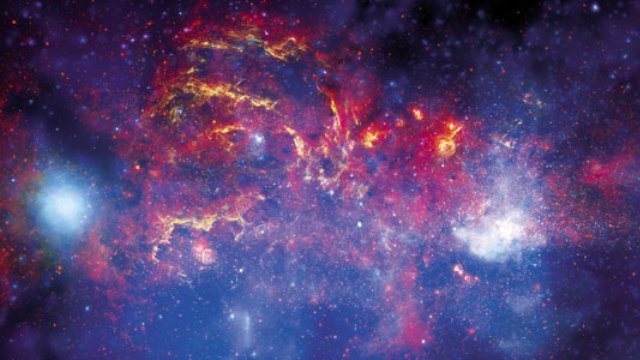
See that shit? It’s the center of the galaxy you’re currently living in. Alasdair Wilkins explains how this pig was made:
This amazing image of the center of our galaxy is the work of three different space telescopes – Hubble, which photographs objects in the visual wavelengths, Chandra, which looks at X-rays, and Spitzer, which investigates the infrared.
Gorgeous. Astrophysicist Giovanni Fazio explains in Wilkin’s article that when ” you look at the universe in different wavelengths, you get a completely different picture. They are all pieces of a puzzle.” True dat.
Behold Megan Burns’ Space Babes In NYC.

Enlarge.
Up until yesterday, I hadn’t heard of Megan Burns. Thanks to the internets and io9, I am now educated. Knowledge has been acquired. Education implemented. Burns is an artist and is putting on a show this weekend in NYC that celebrates something everyone involved in Omega Level fucking loves: pin-up space babes art. You live in NYC, unlike me, and could actually check this awesomeness out? Here’s some deets:
Burns’ paintings will be featured alongside the neon alters of Pavel Kraus in “Ancient Sci-Fi Update,” at The Proposition, which is at 2 Extra Place on New York’s Lower East Side. The opening reception is today (Jan. 22) from 6 to 8 PM, and the show runs until Feb. 27.

Enlarge.
Go to the show. Go to her website. Show the love.
Earth May Be Getting A Second Sun. For A Bit.
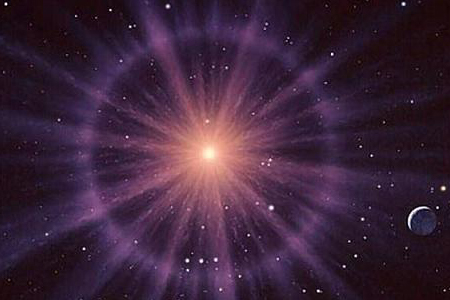
Betelgeuse is a pissed off red supergiant star. Soon, Betelgeuse is going to go supernova. According to Alasdair Wilkins in an article at io9, this is going to be particularly righteous for the citizens of Earth. You know, provided we’re alive and such.
The star is located in the Orion constellation, about 640 light-years away from Earth. It’s one of the bright and biggest stars in our galactic neighborhood – if you dropped it in our Solar System, it would extend all the way out to Jupiter, leaving Earth completely engulfed. In stellar terms, it’s predicted to explode in the very near future. Of course, the conversion from stellar to human terms is pretty extreme, as Betelgeuse is predicted to explode anytime in the next million years.
Out-fucking-standing. Notice the phrase “in stellar terms, it’s predicted to explode in the very near future.” I get the feeling we’re all going to be dead when it occurs. But wait, what is this going to look like?
But still, whether the explosion occurs in 2011 or 1002011 (give or take 640 years for the light to reach Earth), it’s going to make for one of the most unforgettable light shows in our planet’s history. For a few weeks, the supernova will be so bright that there will appear to be two stars in the sky, and night be will indistinguishable from day for much of that time. So don’t count on getting a lot of sleep when Betelgeuse explodes, because the only sensible thing for the world to do will be to throw a weeks-long global supernova party.
A few weeks of permanent daylight across the globe? This is fucking amazing. If you’re often wondering what the point of trudging along in your empty life, and you need a reason to live: stick it out for this.
Via.
High-Res Shot Of Orion Nebula. Daily Space Porn.
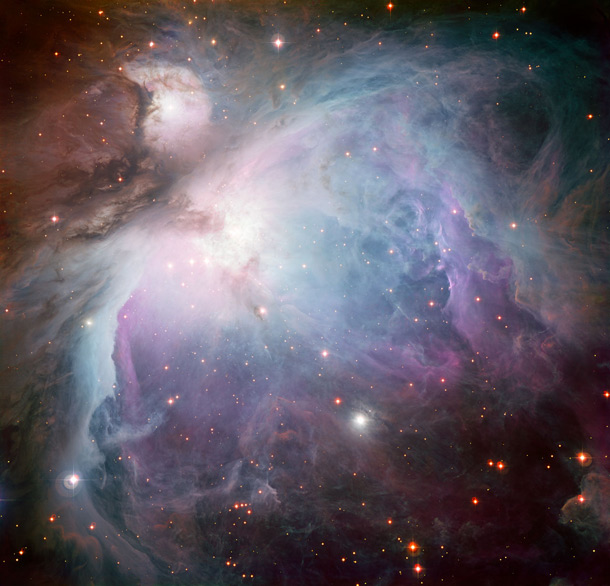
Enlarge. | Super-High Res [142 Mb]. | Via.
Behold!, the Orion Nebula. If you haven’t clicked for the larger version, go, do it! The definition is ridiculous, no? This picture is staggering. As usual, Phil Plait at Bad Astronomy breaks down exactly what we’re looking at:
The nebula is a vast cloud of gas, both atomic and molecular, and dust located about 1350 light years away. It’s one of the largest star forming factories in the Milky Way, and what you see here is well over 20 light years across.
For years I figured it was just a diffuse glowing thing in space, but it turns out to be more complicated than that. In reality, a lot of the nebula is actually a dark, dense molecular cloud – literally, composed of molecules like H2 (molecular hydrogen) and CO (carbon monoxide). This cloud is actually far, far larger than what you see in this image, perhaps 20 times the width! But it’s dark, so we don’t see it in visible light… and what we’re seeing in this picture is not really a free-floating gas cloud, but a cavity in the wall of the denser dark cloud.
Stars are being born inside that cloud. Some of them are very massive, hot, and bright. They blast out a fierce stellar wind, like the solar wind but far more powerful. They also emit a fierce flood of ultraviolet photons. Together, these two forces erode away at the material of the cloud, breaking apart the molecules into their constituent atoms, ionizing them, and causing them to glow. It so happens that some of these stars were born near the side of this cloud, so when they ate away the insides of the cloud it caused a blister in the side which burst open.
You can actually see that in this image! The bulk of the colorful nebula, from the upper left on down, is actually gas inside this cavity set aglow. The far wall is opaque and dark, so you don’t see it here. But you can get a sense of the bubble-like nature of the nebula.
Outstanding. There’s your existential nausea for the day.
Milky Way Galaxy May Be Surrounded By Dark Matter Galaxies. Wut?
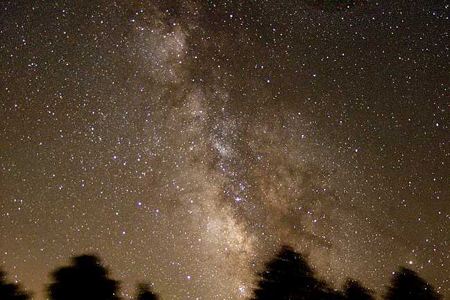
Speculative science is awesome. Especially if you’re into theorizing and not, you know, hardcore facts. This seems to always be the case when talking about sweet-ass outer-space things. You know. Black holes, dark matters. That sort of swag. Well today, we have this wonderful little teaser: is the Milky Way Galaxy surrounded by invisible dark matter galaxies? Dun, dun, dun!
Alasdair Wilkins over at io9 brings the interesting article to the forefront, and this is the dealio. Based on how gravity affects gases at the edge of the Milky Way, we should have a satellite galaxy located 26,000 light-years away. The problem? We ain’t never seen that thang. Wilkins elaborates:
Astronomer Sukanya Chakrabarti looked for gravitational effects created by potential satellite galaxies of our home, the Milky Way. Not unlike the gas giants such as Jupiter of Saturn, the Milky Way has a bunch of relatively tiny “moon” galaxies. The most famous of these, the Magellanic Clouds, are about 10 percent the size of our galaxy, but most of these satellite galaxies are less than a hundredth the size of the Milky Way.
Back in the 19th century, astronomers detected the planet Neptune by observing the slight gravitational wobble of Uranus, which could only be caused by an undetected planet further out. The same basic principle is at work here, as this mysterious Galaxy X is creating movement in the gas at the edge of our galaxy. Chakrabarti suspects the galaxy is composed mostly of dark matter, which is part of the reason why we hadn’t found it up to this point.
If it exists, Galaxy X would be about 1% the size of the Milky Way, making it the third largest satellite after the Magellanic galaxies. While dark matter would make up most of its mass, there would likely still be some dim stars of regular matter in there as well. The galaxy lies on the same plane as our galactic disc, meaning astronomers need to look through all the bright lights of the Milky Way just to see Galaxy X. Still, now that we know where to look, Chakrabarti says, we should be able to find it.
A dark matter galaxy! Interesting shit. I wonder what our dark matter companions are up to? Are they fans of sports? What sort of thing turns them on? Read more.
Behold The Blood Red Whirlpool Galaxy [Of Hell.]
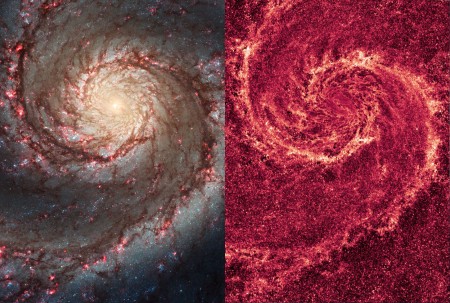
Behold the inner sanctum of Hell! You probably thought that the Devil lived in some dingy-ass cave, right? Shitty halls and screams? Naw, he lives here. Where is here? The Whirlpool Galaxy, but you can call it M51. We have one picture of it on the left, looking all safe and shit. On the right, however, we have its true form exposed. The sanctum of El Diablo.
The Hubble’s site explains the two different views:
The image at left, taken in visible light, highlights the attributes of a typical spiral galaxy, including graceful, curving arms, pink star-forming regions, and brilliant blue strands of star clusters. In the image at right, most of the starlight has been removed, revealing the Whirlpool’s skeletal dust structure, as seen in near-infrared light. This new image is the sharpest view of the dense dust in M51. The narrow lanes of dust revealed by Hubble reflect the galaxy’s moniker, the Whirlpool Galaxy, as if they were swirling toward the galaxy’s core.
Outstanding.
Hit the jump for a high-res version of the Devil’s Regions revealed.
The First Completely Solid Exoplanet Confirmed!
[Enlarge.]
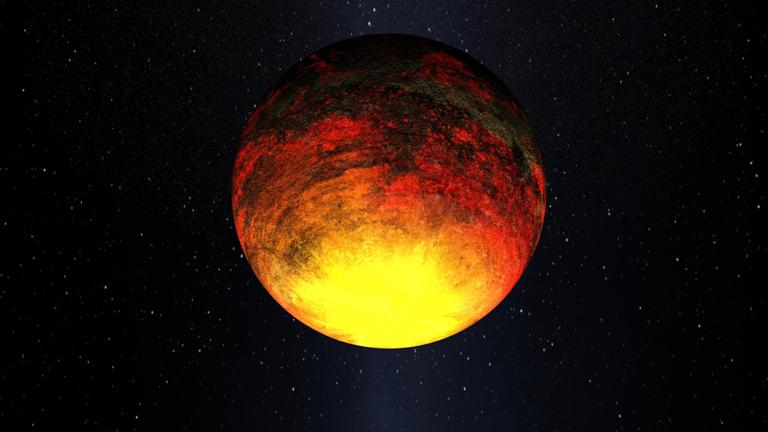
Today, NASA announced the finding of Kepler 10-b, and it’s the first “confirmed discovery of a rocky planet around another star.” Righteous! It’s also the most Earth-like of all the exoplanets that have been found, clocking in at 1.4 times the size of our lovely Blue Marble.
Don’t pack your fucking bags yet though, cautions io9:
Unfortunately, Kepler-10b doesn’t fit any of the other criteria for a potentially habitable planet. It’s 20 times closer to its star than Mercury is to ours, placing it far from the habitable zone that would allow life to survive there. Indeed, Kepler-10b races around its star, completing an orbit every 0.84 days. And, though it’s only 1.4 times the size of Earth, Kepler-10b is a dense world, with a mass 4.6 times that of Earth and an average density similar to an iron dumbbell.
Totally depressed now? Yeah, me too. Frak. Scientist Douglas Hudgins drops some encouraging words:
The discovery of Kepler 10-b is a significant milestone in the search for planets similar to our own. Although this planet is not in the habitable zone, the exciting find showcases the kinds of discoveries made possible by the mission and the promise of many more to come.
Well then! Party on.
More Solar Eclipse Porn, Courtesy of Hinode. [Video.]
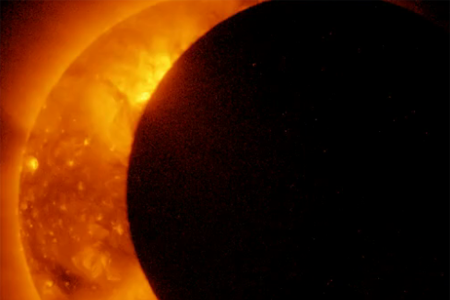
Hinode, NASA’s solar observatory caught the solar eclipse. Oh goodness, it’s a stunning sight. Over at Bad Astronomy, Phil Plait puts it into perspective, saying the “cool thing is the size difference between the Sun and the Moon. The Sun is roughly 400x bigger than the Moon and 400x farther away, so they look about the same size in the sky. But the Moon orbits the Earth in an ellipse, and can change its distance to us by quite a bit, well over 10% – that means its apparent diameter as seen on Earth can change by 10% too.”
Hit the jump for the video. It’s sexy.