



#Space
Time Lapse Video Of Last Night’s Lunar Eclipse Is Beautiful.
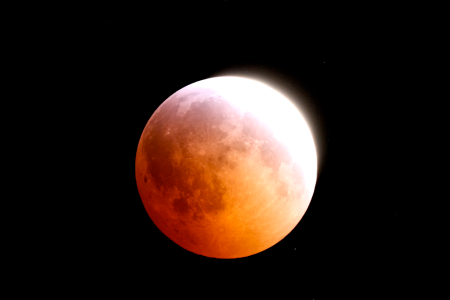
Last night was a lunar eclipse. It was also the darkest day in 372 years. Did you miss it? I sure did. I was tired man! Tired! Lay off. Thankfully William Castleman has brought the world a beautiful time lapse video of the event.
Hit the jump for the video.
3 Comments »
Far Side of the Moon Pictures Are Psychedelic Space Porn
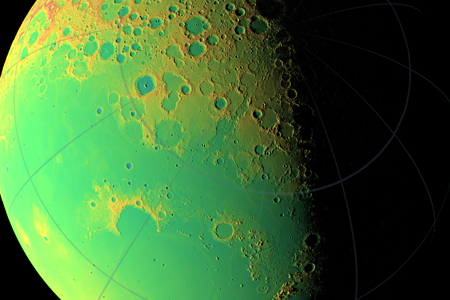
Thanks to NASA’s Lunar Reconnaissance Orbiter, we have the most detailed reliefs of the far side of the moon. Ever! Ever! Oh, technology. The Orbiter was capable of capturing the surface down to thirty-meters. G’damn. The trippy colors? False colors used to denote the various heights. The reds are the highest areas, the blues are the lowest.
Hit the jump for the psychedelic space porn.
Hubble Captures Cosmic Red Ring of Death. Gorgeous.
[Enlarge.]
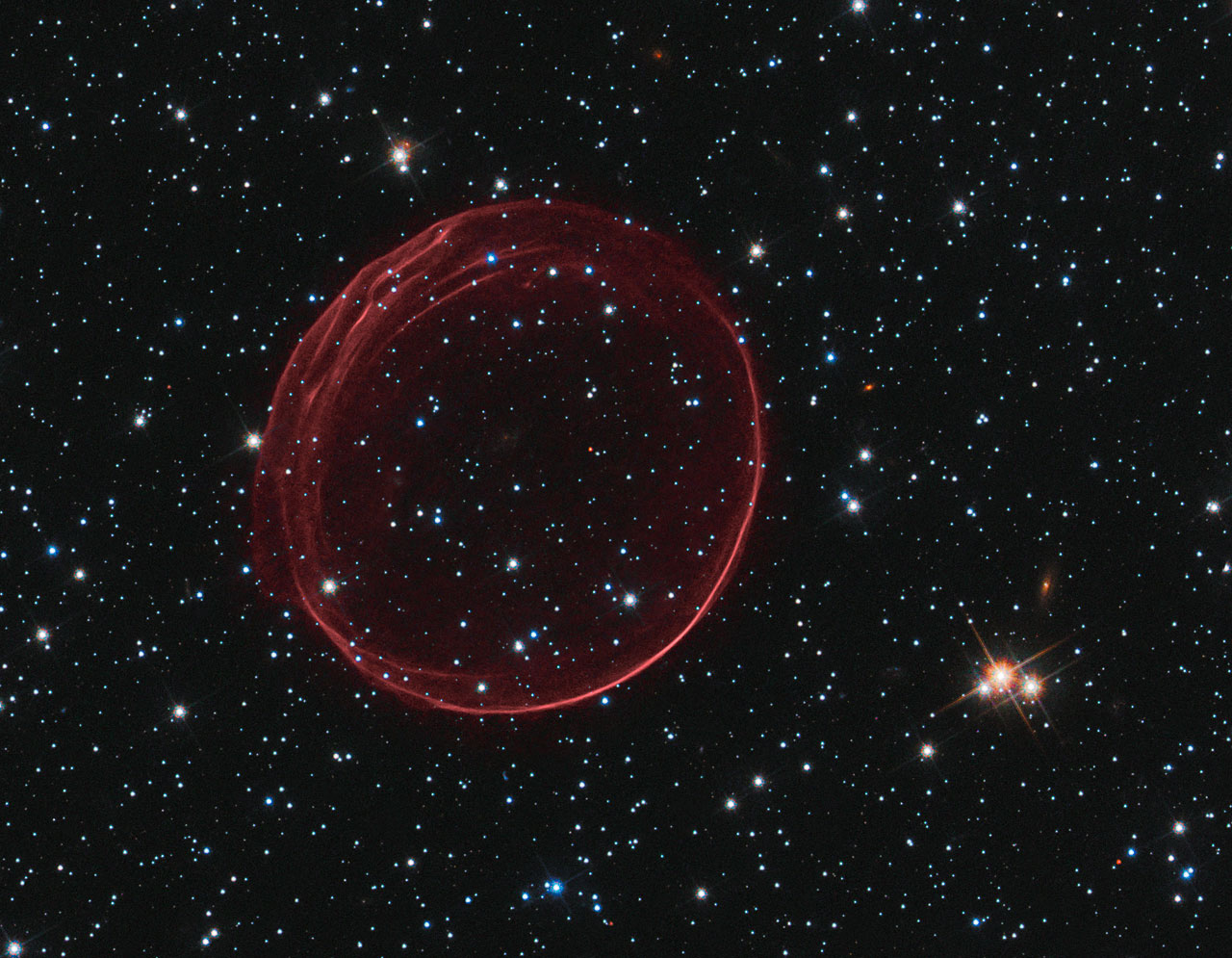
Bad Astronomy posted a link to a recently posted picture over at the Hubble website. This gorgeous red ring is a celestial bauble, and the remnants of a particularly righteous supernova.
Hubble:
The delicate shell, photographed by the NASA/ESA Hubble Space Telescope, appears to float serenely in the depths of space, but this apparent calm hides an inner turmoil. The gaseous envelope formed as the expanding blast wave and ejected material from a supernova tore through the nearby interstellar medium.
[cont]
Astronomers have concluded that the explosion was an example of an especially energetic and bright variety of supernova. Known as Type Ia, such supernova events are thought to result when a white dwarf star in a binary system robs its partner of material, taking on more mass than it is able to handle, so that it eventually explodes.
See kids. Don’t be greedy douches, or you’re going to explode in a wonderful, gorgeous red-ring of death. Let your brother have his toys this Christmas season! If you want to know more about how such a glorious celestial form comes to be, check out Phil Plait’s explanation over on Bad Astronomy. It is the mind warp.
Giant Ice Volcano Found On Titan? Cryovolcano Party!
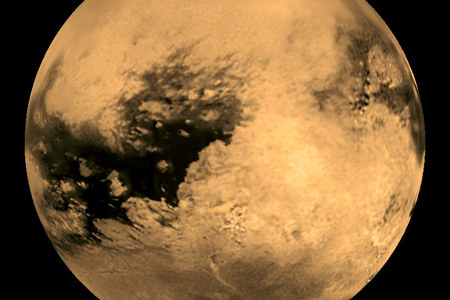
Randy Kirk thinks that there’s an ice volcano on Saturn. And dammit, I hope the guy is right. Tell us more, New Scientist!
Named Sotra, the volcano is nearly 1 kilometre tall and has a 1.6-kilometre-deep pit alongside it. Surrounded by giant sand dunes, it is thought to be the largest in a string of several volcanoes that once spewed molten ice from deep beneath the moon’s surface.
“We think we have found the strongest case yet for an ice volcano on Titan,” said Randy Kirk, a geophysicist at the US Geological Survey in Flagstaff, Arizona. “What we see is not just a flow like we see in other places, it’s like a volcanic field would be on Earth.”
[cont]
The team cannot be certain if the chain is active, but described the find as the best evidence found so far for a cryovolcano, or ice volcano. Previously, bright spots seen in low-resolution satellite images have been interpreted as volcanic flows and craters. However, once those areas were mapped in 3D, it became obvious they weren’t volcanoes.
“We had noted Sotra Facula as a candidate cryovolcano before,” said Rosaly Lopes at NASA’s Jet Propulsion Laboratory in Pasadena, California. “But it was only when Randy got the topography done that we realised, wow, this is it.”
Righteous. But what is even more righteous? The concept of a fucking cryovolcano. You can’t just call that shit an ice volcano. That sounds pedestrian! Cryovolcano! A volcano that shoots molten ice. I have a space-dork chubby. This shit ounds like something I absolutely need to cast in an RPG.
Watch A Whole Hemisphere Of The Sun Explode. [Video.]
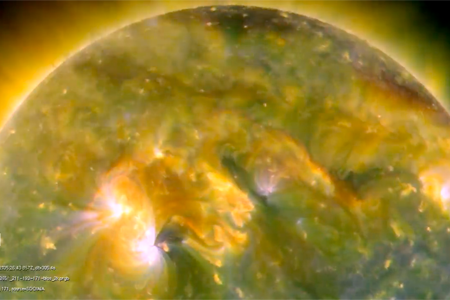
This is fucking marvelous. An entire hemisphere of the sun explodes which then ignites another region. According to io9, this was an event previously thought impossible:
In this ultraviolet light video taken by NASA, you can watch a phenomenon that scientists didn’t believe could exist until a few months ago. An entire hemisphere of the sun explodes, one region igniting another. What does this discovery mean?
It turns out that the sun doesn’t just spurt out gouts of gas in isolated spots. In fact, our star’s magnetic field brings many regions of Sol’s surface into direct relationships with each other, so areas separated by millions of miles can literally spark each other up. The results are called “sympathetic flares.”
G’damn amazing. Hit the jump to watch the explosion in action.
Saturn’s Rings Are The Remains Of An Exploded Moon. Space Is Awesome.
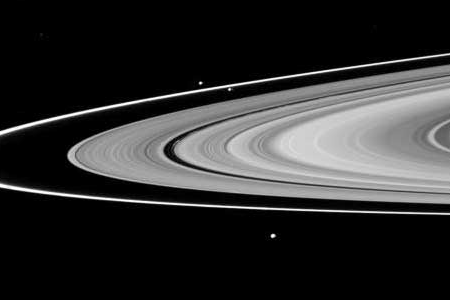
Every space junkie knows how fucking sexy Saturn’s rings are. But fuck, I don’t know about you, but I didn’t know this. Saturn’s rings are the remnants of an exploded moon. What? Awesome.
io9:
Saturn’s rings are among the most iconic sights in the solar system, but where did they come from? Long ago, an icy moon was ripped apart by Saturn’s gravity, creating rings once a 100 times bigger than they are now.
100 times bigger? Good lord. how big are they now? I looked that shit up for us, and they’re 275,000 kilometers which is “is a little less than the distance between the Earth and Moon.” Fantastic.
4.5 billion years ago, as the solar system was still in its primordial stages, Saturn was likely home to a number of large moons. These days, Titan is its only really big moon, as its lost siblings were likely pulled into Saturn by its gravity and destroyed. Most of the moons would have exploded within Saturn’s giant gaseous atmosphere, leaving no trace of their former existence. But the last moon to be pulled apart would have left a remarkable memorial behind: Saturn’s ring system.
[cont.]
But as huge and remarkable as Saturn’s rings are, an explosion of that size would create much, much bigger rings. A Titan-sized moon would probably create a ring system anywhere between 10 and 100 times bigger than what we see today. It’s hard to imagine just how awe-inspiring it would be to look upon Saturn all those billions of years ago with a sight like that waiting for us.
Over the eons, the rings would have steadily shrank, as parts of the ice fell back into Saturn and others drifted out into further orbits, where they would have clumped together and began to form new moons. Saturn’s inner moons all have masses and compositions that fit in with such an explanation very nicely, which is a good boost for the veracity of this new theory.
Goddamn fantastic.
Wide Lens Time-Lapse Video of The Stars Is Cosmic Porn.
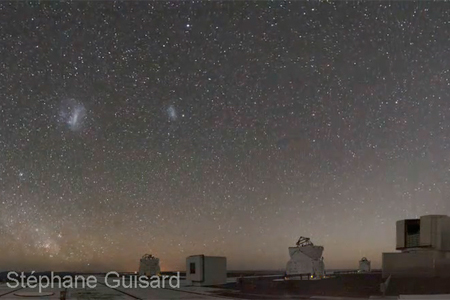
Over at Bad Astronomy they posted this video by Stéphane Guisard. Using a fish-eye lens he managed to capture the entire fucking night sky in Chile. The results are nothing short of existential tits-hardening. Watch as the colors change and the Earth dances about the cosmos.
Hit the jump for the video.
Loop Of Solar Plasma Is Half A Million Miles Long. Crazy Space Ejaculate!
[Enlarge.]
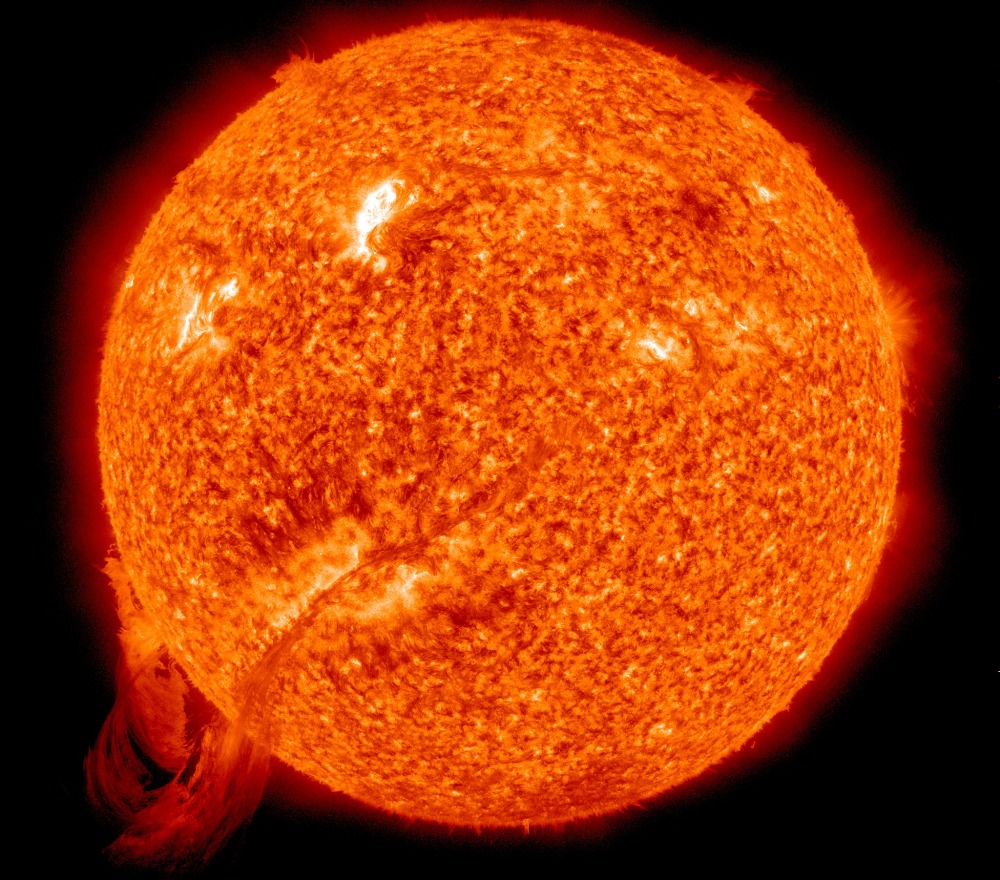
Ready for some existential nausea? Today magical astronomer wizards spotted an insane solar prominence. The whacky space ejaculate rippled out into space. Like, really rippled out there. The solar loop of plasma is half a million miles long.
These features are known as prominences, and they form in the sun’s photosphere. Cooler plasma pushes out into the hotter, ionized gases of the Sun’s corona, creating massive loops that take about a day to form but can sometimes persist for months. This particular prominence, one of the biggest we’ve ever seen, isn’t expected to last much longer than a few hours, after which it should harmlessly break up.
But right about now, there’s a loop of plasma running around the Sun that could encircle the Earth twenty times over.
That’s god damn impressive. That rippling prominence can encircle the Earth twenty times. And as always, remember how god damn small the Sun is, compared to other suns. Oh the cosmos, I fucking adore you.
Via.
NASA Is About To Announce The Existence of Extraterrestrial Life? Tin Foil Hats Alert!
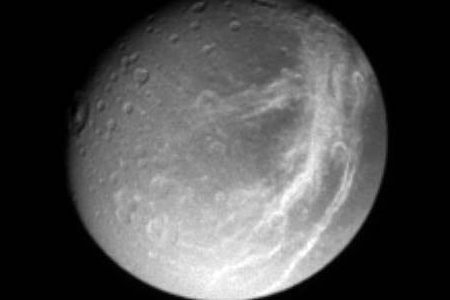
Oh shit! Fresh in time for the holiday season, where we glue bibles to our hearts and proclaim the coming of our Lord, NASA may be about to throw a curve ball into our collective balls. Maybe! It’s always maybe, isn’t it? Fuck me, I know. NASA is gathering an impressive collection of folks to speak at a press conference on Thursday. Who do you ask? Why, none other than an oceanographer, a biologist, and an ecologist! Wait, that doesn’t mean anything to you? Yeah, me neither.
io9 explains:
Blogger Jason Kottke did some inspired sleuthing regarding what Thursday’s press conference might be about. He discovered the expertises of the various people involved include the interaction of geology and life on alien planets (specifically Mars), photosynthesis using arsenic, Saturn’s moon Titan as an early Earth environment, and the chemistry of life, including in places without carbon, water, or oxygen.
Taking that all together and combined with the current blitz of news from NASA’s Cassini probe around Saturn, Kottke guesses the announcement might have something to do with the discovery of arsenic on Titan and, quite possibly, some primitive bacterial form of life using it for photosynthesis.
Well, shit. I thought they were about to inform us of the existence of a species of nine-foot tall blond women with breasts unbothered by gravity, who only want nothing more than to procreate with us. All of us. And give us eternal life. But seriously though, this was be fun as fuck. Some incontrovertible proof of life afar? Even if it’s just some bacteria hanging out? Hey man, we came from fuggin’ muck. This would be dope.
Time to get those Bible Editors out, and talk about the time that God sneezed on Titan!
Saturn’s Moon Rhea Has A Breathable Atmosphere? Mayhaps! Space Party!

What are we going to do when we consummate the inevitable? You know, destroying the Earth? Well, I don’t know about you guys, but I’ll be throwing a fucking kegger on Rhea. It appears that one of Saturn’s sixty moons has a breathable atmosphere.
io9:
Saturn’s icy moon Rhea has an oxygen and carbon dioxide atmosphere that is very similar to Earth’s. Even better, the carbon dioxide suggests there’s life – and that possibly humans could breathe the air.
It seems oxygen is far more abundant than we ever suspected, particularly on moons that seem to be completely frozen solid. We recently found evidence of oxygen on Jupiter’s moons Europa and Ganymede, and now this finding on Europa. In fact, because the region of space surrounding Saturn’s rings has an oxygen atmosphere, it’s thought even more of the icy moons within the gas giant’s magnetosphere likely have little atmospheres of their own.
According to new data from the Cassini probe, the moon’s thin atmosphere is kept up by the constant chemical decomposition of ice water on the surface of Rhea. It’s likely that Saturn’s fierce magnetosphere is continually irradiating this ice water, which is what helps to maintain the atmosphere. Researchers suspect a lot of Rhea’s oxygen isn’t actually free right now, but is instead trapped inside Rhea’s frozen oceans.
Maybe. Fucking scientists. Someday there will be a statement that has the words “absolutely” or “certainly” or “positive” that I can get psyched for. I’m waiting for the proclamation that’s like “Definitely hot chicks and Mountain Dew on Mars! Plus, small boners are cool there.” Try and stop me from getting on that space shuttle.